

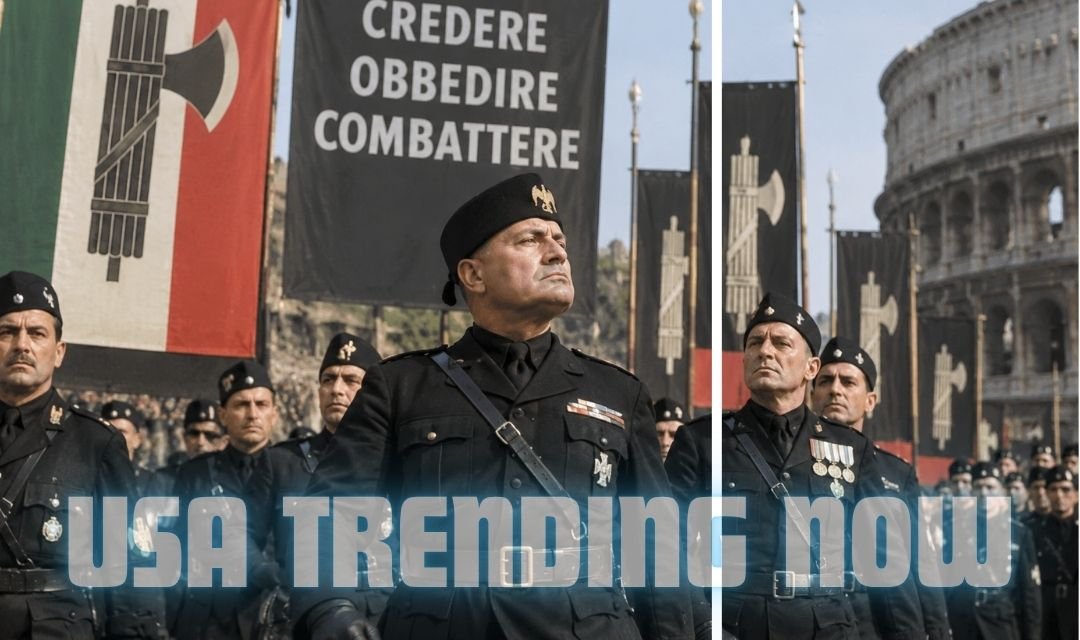
Fascisterne is a Danish word that directly means “the fascists” in English. It describes people who support fascism rather than the ideology itself. The authoritative Danish dictionary entry for fascist in Den Danske Ordbog gives the plural ending -er and definite plural ending -erne, which produces fascisterne. Although the word can appear in modern political arguments, it is most useful historically when discussing fascist movements in Europe, including Denmark’s Nazi-inspired Danmarks Nationalsocialistiske Arbejderparti (DNSAP) during the years surrounding World War II.
Quick Facts About Fascisterne
| Detail | Information |
|---|---|
| Word | Fascisterne |
| Language | Danish |
| English Meaning | The fascists |
| Singular | Fascist |
| Indefinite Plural | Fascister |
| Definite Plural | Fascisterne |
| Related Word | Fascisme — fascism |
| Refers To | People or groups supporting fascism |
| Historical Period Most Associated With | 1920s–1940s |
| Famous Fascist Leader | Benito Mussolini |
| Danish Nazi Party | DNSAP |
| DNSAP Founded | November 16, 1930 |
| Founder | Cay Lembcke |
| Later Leader | Frits Clausen |
| DNSAP Seats in 1939 | 3 |
| DNSAP Seats in 1943 | 3 |
| German Occupation of Denmark | April 9, 1940–May 1945 |
| Modern Usage | Historical term and sometimes political label |
Den Danske Ordbog defines a fascist as a supporter of fascism. Its grammar entry shows the forms fascisten, fascister and fascisterne, making the meaning of the search term especially clear.
What Does Fascisterne Mean?
The easiest translation is:
Fascisterne = the fascists.
It is not the Danish word for fascism itself.
That word is:
fascisme.
This difference matters.
Think about it this way:
Fascisme = the political ideology.
Fascist = one person who supports it.
Fascister = fascists.
Fascisterne = the fascists.
The Danish dictionary defines fascist as a person who supports fascism and also notes a broader figurative use for someone associated with strongly authoritarian or nationalist political ideas.
So when a Danish history book uses fascisterne, it may simply be talking about a specific group of fascists already mentioned in the text.
It is not necessarily the name of one organization.
Is Fascisterne the Name of a Political Party?
No.
This is one of the biggest misunderstandings surrounding the keyword.
Fascisterne is not itself the official name of Denmark’s fascist party.
It is a normal Danish grammatical word meaning “the fascists.”
Different fascist individuals and organizations can therefore be described as fascisterne depending on the context.
The best-known Nazi political party in Denmark was called:
Danmarks Nationalsocialistiske Arbejderparti, usually shortened to DNSAP.
Lex, Denmark’s national encyclopedia, says DNSAP was founded on November 16, 1930 by Cay Lembcke.
What Is Fascism?
Fascism is an authoritarian and ultranationalist political ideology.
The United States Holocaust Memorial Museum describes fascism as combining extreme nationalism, authoritarianism, militarism and opposition to pluralistic democratic government. It places the national community above individual rights and favors strong leadership rather than liberal democratic institutions.
Den Danske Ordbog similarly describes fascisme as a political movement that places the state and people above the individual and sets democracy aside through dictatorial methods.
In simple language, fascist systems tend to argue:
the nation must come first,
a powerful leader is necessary,
political opposition is dangerous,
individual freedoms can be restricted,
and force may be justified to achieve political goals.
Historically, fascist governments also relied heavily on propaganda, mass political movements and the suppression of opponents.
Where Did the Word Fascism Come From?
The word has roots in ancient Rome.
Den Danske Ordbog traces fascisme to the Latin fascis, referring to a bundle of rods associated with Roman political authority.
The ancient symbol known as the fasces usually showed rods tied together, sometimes surrounding an axe.
Centuries later, Italian fascists adopted this imagery.
It helped communicate an idea they liked:
one stick may break easily, but many sticks tied together are stronger.
That symbolism fit a movement that emphasized unity, state power and obedience to centralized authority.
How Did Modern Fascism Begin?
Modern fascism developed most famously in Italy after World War I.
Benito Mussolini built a movement that rejected liberal democracy and promised national strength, order and renewal.
Italy had experienced:
economic instability,
political conflict,
fear of revolution,
anger over the outcome of World War I,
and growing street violence.
Mussolini used those conditions to build support.
His movement eventually took power in the early 1920s and created a dictatorship.
Fascist ideas then influenced movements elsewhere in Europe.
Are Fascism and Nazism the Same Thing?
Not exactly.
They overlap strongly, but they are not identical terms.
Nazism was the ideology of Adolf Hitler and Germany’s National Socialist German Workers’ Party.
It shared many characteristics with fascism, including:
authoritarian leadership,
extreme nationalism,
rejection of liberal democracy,
political violence,
militarism,
and suppression of opponents.
However, Nazi ideology placed an especially central emphasis on supposed racial hierarchy, antisemitism and territorial expansion.
The Holocaust Museum explains that Hitler’s program centered on nationalism, antisemitism and expansion and was tied to the idea of a German national community defined through supposed racial categories.
So historians often classify Nazism as a form of fascism while also recognizing its distinctive racial ideology.
Were There Fascisterne in Denmark?
Yes.
Denmark had several far-right and fascist movements.
The most important Nazi-inspired political party was DNSAP.
According to Lex, DNSAP openly copied Germany’s Nazi Party in several important ways.
It copied:
the leader principle,
the swastika,
organizational structure,
racial ideology,
antisemitism,
and opposition to both liberalism and Marxism.
That makes DNSAP one of the clearest historical examples of people who could be described in Danish as fascisterne.
Who Founded DNSAP?
DNSAP was founded by Cay Lembcke on November 16, 1930.
He did not remain its leader for long.
In July 1933, Frits Clausen replaced Lembcke as the party’s leader.
Clausen became the most recognizable face of Danish Nazism.
He was a doctor and politician from southern Denmark.
Lex reports that he had joined DNSAP in 1931 before becoming its “fører,” or leader, in 1933.
Who Was Frits Clausen?
Frits Clausen was born on November 12, 1893.
He trained as a doctor and eventually entered politics.
His political importance came almost entirely from his leadership of DNSAP.
Under Clausen, the party tried to turn German-style National Socialism into something Danish voters would support.
That was difficult.
DNSAP copied so much from Hitler’s German movement that its claim to represent independent Danish nationalism could appear contradictory.
Lex specifically notes that the party’s strong connection with Germany made it difficult for DNSAP to present itself as a purely Danish nationalist movement.
How Popular Was DNSAP Before World War II?
Not very popular nationally.
According to Lex, DNSAP had around 5,000 members in 1939.
That year it entered Denmark’s parliament with just three seats.
The party did have areas of stronger support, particularly in southern Denmark.
But it never became a mass electoral movement comparable to the Nazi Party in Germany.
This is an important point.
The existence of Danish fascists does not mean most Danes supported fascism.
They did not.
Germany Invaded Denmark in 1940
Nazi Germany invaded Denmark on April 9, 1940.
Aarhus University’s danmarkshistorien.dk explains that German land, air and naval forces attacked Denmark early that morning. Danish military resistance was limited, and the government ordered fighting to stop after only a few hours because of Germany’s overwhelming military advantage.
Denmark then entered a complicated period of occupation.
The Danish government and many institutions initially continued functioning under German occupation.
This created a situation different from several other German-occupied countries.
Did DNSAP Take Power After Germany Occupied Denmark?
No.
DNSAP hoped it would.
That was one of the most important failures in the history of Danish Nazism.
The party believed Germany’s occupation might provide a path to political control.
Lex says DNSAP hoped to gain power through German assistance, but Germany expected it first to show meaningful popular support.
That never happened.
Even with German financial help, the party could not win widespread support.
How Large Did DNSAP Become?
The party did grow during the occupation.
Lex estimates that membership rose from about 5,000 in 1939 to approximately 21,500 by early 1943.
That sounds like dramatic growth.
But election results showed something different.
Membership did not translate into broad public support.
At the March 1943 election, DNSAP still won only three parliamentary seats.
The result was a major disappointment.
Afterward, the party moved toward partial disintegration.
Why Didn’t Danish Fascists Become More Popular?
There were several reasons.
First, parliamentary democracy already had deep roots in Denmark.
Second, DNSAP’s close imitation of Hitler’s German party damaged its nationalist message.
Imagine saying:
“We are the true defenders of Denmark”
while copying the symbols and political style of the foreign power occupying Denmark.
That contradiction was difficult to ignore.
Third, most Danish voters continued supporting established democratic parties.
Even during occupation, Danish fascists remained politically marginal compared with mainstream parties.
Did Every Danish Collaborator Belong to DNSAP?
No.
This distinction is very important.
A person could collaborate economically or politically with Germany without being a DNSAP member.
Likewise, someone could hold far-right views without belonging to that specific party.
The history of occupation involved many different groups:
government officials,
businesses,
ordinary citizens,
resistance members,
German authorities,
Danish Nazis,
military volunteers,
and people trying simply to survive.
Using fascisterne as if it described everybody who cooperated with Germany would therefore be historically inaccurate.
Fascisterne and Antisemitism
Antisemitism was part of DNSAP’s ideology.
Lex specifically describes racial doctrine and associated antisemitism as elements copied from Germany’s Nazi movement.
This matters because Nazi antisemitism was not simply political rhetoric.
Across German-controlled Europe it became connected with persecution, deportation and ultimately genocide.
Denmark’s Jewish population faced its greatest immediate danger in 1943 when German authorities prepared a mass arrest and deportation operation.
The Rescue of Denmark’s Jews
One of the most important parts of Denmark’s wartime history was the rescue of most of the country’s Jewish population.
In autumn 1943, information about the planned German deportation operation reached Danish circles.
Ordinary citizens, resistance members and fishermen helped Jewish families hide and travel toward the coast.
The United States Holocaust Memorial Museum reports that approximately 7,200 Danish Jews and around 700 non-Jewish relatives reached neutral Sweden.
About 470 Danish Jews were deported to Theresienstadt, according to the museum.
Most survived.
The episode became one of the best-known rescue operations of the Holocaust.
Fascisterne vs. the Danish Resistance
The Danish resistance moved in almost the opposite political direction from collaborationist and Nazi groups.
Resistance activities included:
illegal newspapers,
intelligence,
sabotage,
helping fugitives,
and later armed action.
The resistance expanded as the occupation continued.
The rescue of Danish Jews in 1943 became one of its most famous efforts, although many people outside formal resistance networks also helped.
Therefore, Danish World War II history cannot be reduced simply to “Denmark versus fascisterne.”
The reality contained collaboration, accommodation, resistance and changing attitudes over five years.
Did Danish Fascists Fight for Germany?
Some Danish volunteers did serve alongside German forces.
Frikorps Danmark, or Free Corps Denmark, became associated with Danish volunteers fighting against the Soviet Union.
However, it is useful to distinguish the military volunteer movement from DNSAP itself.
Their memberships and political networks overlapped, but they were not simply identical organizations.
Many volunteers were influenced by:
anti-communism,
Nazism,
militarism,
or German sympathies.
Others had different personal motives.
Historical precision matters when discussing these groups.
What Happened to Danish Nazis After the War?
Germany surrendered in Denmark in May 1945.
After liberation, Denmark began a legal process commonly known as the retsopgør, or postwar legal reckoning.
People accused of serious collaboration faced investigation and prosecution.
Cases involved activities such as:
working directly for German security services,
violent collaboration,
joining certain German organizations,
and other forms of assistance to the occupation.
The postwar process became a complicated part of Danish history because lawmakers and courts had to decide how to judge actions committed during occupation.
Why Is the Word Fascisterne Still Used Today?
Because fascism did not disappear from historical discussion after 1945.
The word appears today in:
history books,
documentaries,
schoolwork,
newspapers,
political debates,
museum exhibitions,
and discussions about extremist movements.
Den Danske Ordbog also recognizes a broader figurative use of fascist for people associated with highly authoritarian or strongly nationalist positions.
But that wider usage requires care.
Calling someone a fascist is a serious political label.
It should not simply mean:
“I strongly disagree with this person.”
Is Fascisterne a Left-Wing or Right-Wing Term?
Historically, fascism is generally classified as a far-right authoritarian ideology.
The Holocaust Museum describes fascism as opposing socialism, communism, pluralism, equality and representative democratic government while emphasizing ultranationalism and authoritarian leadership.
Modern political arguments can become messy because people sometimes use “fascist” as a general insult.
Historical analysis should instead look for specific characteristics.
For example:
Does a movement reject democratic pluralism?
Does it organize around an authoritarian leader?
Does it promote ultranationalist exclusion?
Does it celebrate political violence?
Does it seek to remove basic rights from groups considered outside the nation?
Those questions are much more useful than simply attaching labels.
Are All Dictators Fascists?
No.
A dictatorship can exist without being fascist.
Authoritarian governments have appeared under many different ideologies.
A military dictatorship, communist dictatorship, personalist dictatorship and fascist state may all restrict political freedom.
But that does not make them ideologically identical.
Fascism has its own historical patterns involving ultranationalism, national rebirth, mass politics, authoritarian leadership and hostility toward liberal democratic pluralism.
Are All Nationalists Fascists?
No.
Nationalism by itself does not automatically equal fascism.
Someone may strongly support their country while still supporting:
free elections,
independent courts,
freedom of speech,
equal citizenship,
and peaceful political competition.
Historical fascism goes much further.
It combines intense nationalism with authoritarian politics and rejection of important democratic principles.
That distinction prevents the word from becoming meaningless.
Fascisterne in Modern Political Arguments
The term sometimes appears today as a label aimed at political opponents.
That can create confusion.
If every authoritarian idea is automatically called fascism, the historical term can lose precision.
But if people refuse to use the term even when clearly fascist characteristics appear, that can also hide useful historical comparisons.
A sensible approach is to examine behavior and ideology rather than starting with the label.
Ask:
What does the movement believe?
What does it say about elections?
How does it treat opposition?
How does it define citizenship?
Does it promote violence?
Does it recognize equal rights?
Historical comparison works best when it is based on evidence.
Fascisterne vs. Fascisme
This simple language table can help:
| Danish | English |
|---|---|
| Fascist | A fascist |
| Fascisten | The fascist |
| Fascister | Fascists |
| Fascisterne | The fascists |
| Fascisme | Fascism |
| Fascistisk | Fascist / fascistic |
So if someone searches “fascisterne meaning”, they do not need an invented organization or website explanation.
It is a genuine Danish word.
Is Fascisterne a Website or Brand?
There is no reason to assume so from the keyword alone.
Unlike unusual terms such as some modern startup names, fascisterne already has a clear dictionary meaning.
It is simply Danish grammar applied to the noun fascist.
A book, podcast, article or documentary could certainly use Fascisterne as a title.
But that would be using an existing word.
The title would usually translate roughly as The Fascists.
Why Is Fascisterne Important to Danish History?
Because Denmark’s wartime history included its own fascist and Nazi movements.
DNSAP never captured widespread national support.
But it existed.
It had thousands of members.
It entered parliament.
It copied German Nazi ideology and symbols.
And during occupation it hoped German power would provide an opportunity to take control.
Understanding that history prevents an overly simple picture of Denmark during World War II.
There were people who resisted Nazism.
There were people who collaborated.
There were Danish Nazis.
And there were many people whose behavior fell somewhere between resistance and ideological collaboration.
What We Actually Know About Fascisterne
The most reliable facts are straightforward.
Fascisterne means “the fascists” in Danish.
The word comes from fascist, whose plural is fascister and definite plural is fascisterne.
It is connected with fascisme, the Danish word for fascism.
Historically, fascism developed as an authoritarian ultranationalist ideology in Europe after World War I.
Denmark had its own Nazi-inspired party, DNSAP.
DNSAP was founded in 1930.
Frits Clausen became leader in 1933.
It copied Nazi Germany’s leader principle, symbols, racial doctrine and antisemitism.
The party entered parliament with three seats in 1939.
Despite membership increasing during German occupation, it again won only three seats in 1943.
It never became Denmark’s dominant political movement.
Final Thoughts
Fascisterne may look like the name of a mysterious organization when an English-speaking reader first sees it.
But the basic meaning is much simpler.
It means:
“the fascists.”
That small translation opens the door to a much bigger history.
Modern fascism emerged in Europe after World War I and became most strongly associated with Benito Mussolini’s Italy. Similar authoritarian and ultranationalist movements developed elsewhere, while Hitler’s Nazism added an especially extreme racial and antisemitic ideology that culminated in the Holocaust.
Denmark was not untouched by these ideas.
DNSAP was founded in 1930 and later led by Frits Clausen. It copied important elements of Germany’s Nazi Party but struggled to gain broad public support. Even during occupation, when party membership reached approximately 21,500, it won only three seats in the 1943 election.
At the same time, another side of Danish wartime history became internationally famous.
In 1943, Danish citizens and resistance networks helped thousands of Jewish people escape to Sweden before German deportation plans could be fully carried out. The Holocaust Museum estimates that around 7,200 Jews and hundreds of non-Jewish relatives reached safety.
So the history surrounding fascisterne is not simply about one political word.
It is about democracy and dictatorship.
Collaboration and resistance.
Nationalism and occupation.
Persecution and rescue.
For readers searching for Fascisterne, the clearest answer is this: it is the Danish definite plural of “fascist,” meaning “the fascists.” It is not the formal name of one party, although the word is especially relevant to historical discussions of fascist and Nazi movements such as Denmark’s DNSAP.
Frequently Asked Questions About Fascisterne
What does Fascisterne mean?
Fascisterne means “the fascists” in Danish.
Is Fascisterne a Danish word?
Yes. It is the definite plural of the Danish noun fascist.
What is the singular of Fascisterne?
The singular is fascist.
What does fascister mean?
Fascister means fascists without the definite “the.”
What does fascisme mean?
Fascisme is the Danish word for fascism, the ideology rather than its followers.
Is Fascisterne a political party?
No. It is a general Danish word. Denmark’s best-known Nazi party was DNSAP.
What was DNSAP?
DNSAP stood for Danmarks Nationalsocialistiske Arbejderparti, a Danish Nazi party founded in 1930.
Who founded DNSAP?
Cay Lembcke founded it.
Who was Frits Clausen?
Frits Clausen was a Danish doctor and politician who became leader of DNSAP in 1933.
Was DNSAP based on Hitler’s Nazi Party?
Yes. Lex says it copied the German Nazi Party’s organization, leader principle, symbols and important ideological elements, including racial doctrine and antisemitism.
How many members did DNSAP have?
Lex estimates roughly 5,000 in 1939 and around 21,500 by early 1943.
Did Danish fascists win many elections?
No. DNSAP won only three seats in both the 1939 and 1943 parliamentary elections.
Did Germany occupy Denmark?
Yes. Germany invaded Denmark on April 9, 1940.
Did DNSAP take control of Denmark?
No. Despite hoping German support would help it gain power, the party never attracted enough popular support.
Is fascism the same as Nazism?
They overlap heavily, but they are not completely identical. Nazism combined authoritarian ultranationalism with an especially central racial and antisemitic ideology.
Are all fascists Nazis?
No. Fascism existed in movements outside Nazi Germany.
Are all dictators fascists?
No. Dictatorships can follow different political ideologies and structures.
Are all nationalists fascists?
No. Nationalism alone does not make someone fascist.
What happened to Danish Jews during World War II?
In 1943, a large rescue operation helped approximately 7,200 Danish Jews escape to Sweden.
Is Fascisterne still used today?
Yes. It remains a normal Danish word and can appear in historical writing and modern political discussion.
Why should the word fascist be used carefully?
Because fascism has a specific historical meaning involving authoritarianism, ultranationalism and rejection of democratic pluralism. Using it merely as an insult can make historical discussion less precise.
For more history explainers, trending terms and easy-to-understand guides, visit USA Trending Now.