

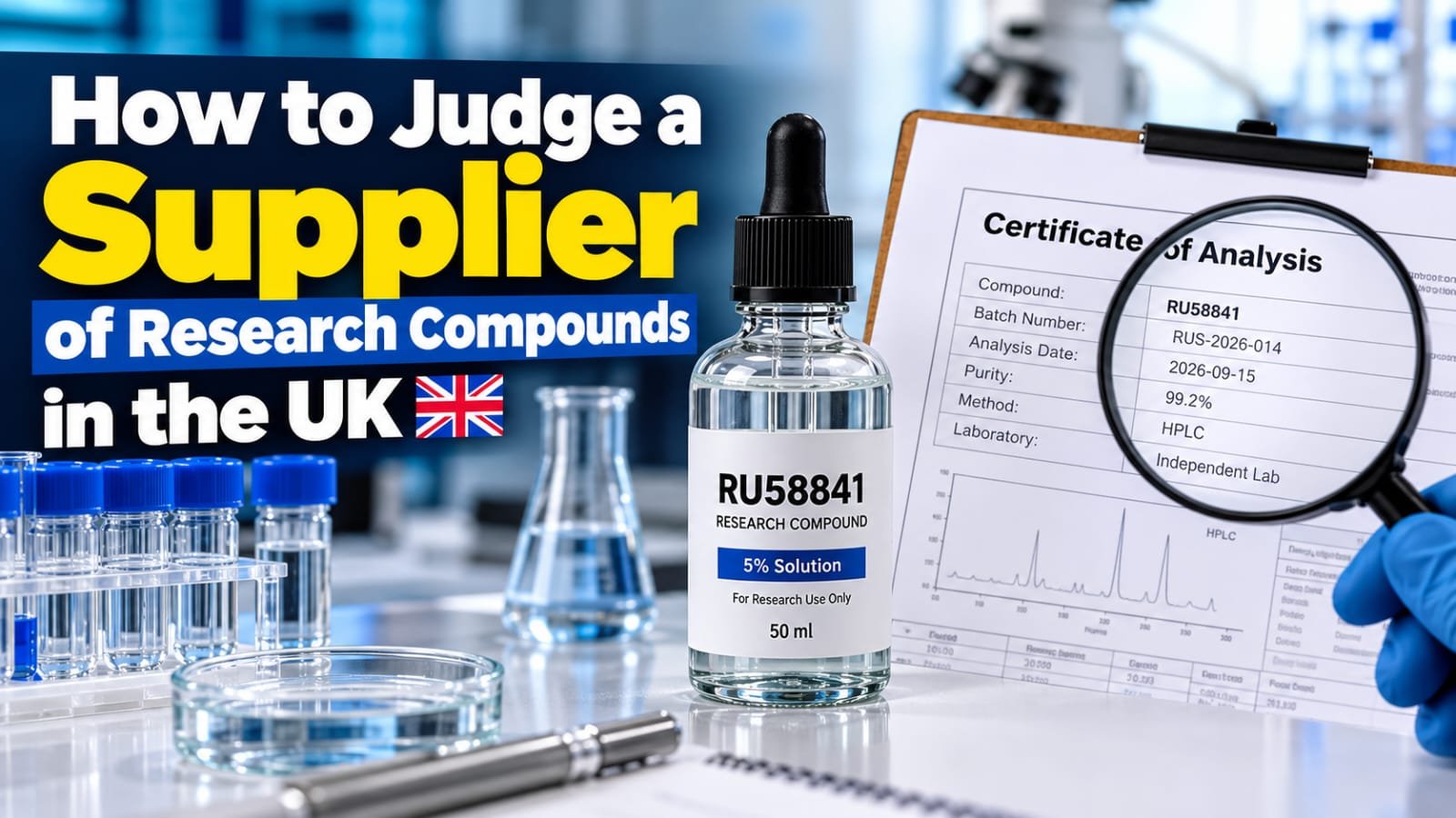
Choosing a supplier for an experimental compound comes down to evidence. Look for independent test results that can be checked, a company that can be traced, and a price that makes sense. Anyone searching buy ru58841 uk will find plenty of sellers, and the same compound can arrive at very different strengths depending on who made it. Labs and researchers need some way of knowing that what’s in the bottle matches what’s on the label.
Why Supplier Quality Varies So Much
With no licensing body checking each batch, quality depends entirely on the seller. Some suppliers source from established manufacturers and test every lot. Others relabel cheap stock without checking it at all.
Problems that come up include solutions weaker than stated, powders cut with fillers, and batches containing the wrong compound entirely. For research work, any of these can ruin results. A study built on a solution labelled 5% that actually measures 2% isn’t measuring what it claims to measure.
Typing buy ru58841 uk into a search engine brings up a long list of shops, but a test report is the one claim that’s hard to fake if someone actually checks it. That makes testing the sensible place to start any comparison.
Reading a Certificate of Analysis
A Certificate of Analysis, or CoA, is a lab report showing what a sample actually contains. A useful one includes the following details.
- The name of the independent laboratory that ran the test
- A unique report or task number
- The date the test was carried out
- The measured purity or concentration, not just the claimed figure
- The method used, such as HPLC or mass spectrometry
- A clear link between the sample tested and the batch being sold
The most important step is verification. Many testing labs let anyone look up a report using its reference number. A CoA that can’t be traced back to the lab that issued it proves very little. Reports from the supplier’s own in house lab carry less weight than those from a named third party.
Checking the Company Behind the Product
A traceable business is easier to hold to account if something goes wrong. A few quick checks tell a lot.
- Look the company up on Companies House and confirm it’s active
- Check that the registered name matches the name on the website
- Look for a physical UK address and a working support email
- Read the returns and refund policy before ordering
- Note whether the seller makes medical claims, since reputable ones avoid them
- Search for independent reviews outside the supplier’s own site
A seller with no company details, no returns policy and promises of dramatic results is best avoided.
Price as a Warning Sign
Research chemicals have a rough going rate, and serious suppliers tend to sit within it. A price far below what most sellers charge usually means something has been cut. That might be the concentration, the testing or the purity.
Very high prices don’t guarantee quality either. The best guide is a fair price backed by test results that can be verified. Multi buy discounts are common and not a concern in themselves, as long as every bottle comes from a tested batch.
Storage and Handling in the Lab
Research compounds should be handled like any other laboratory chemical. Storage instructions on the label should be followed, which usually means keeping the material cool, dry and away from light. Solutions in glass bottles need padded packaging in transit and careful storage once opened.
Labelling matters too. Each container should show the compound, concentration, batch number and date received. That makes it possible to match results to a specific batch if questions come up later.
Evidence Before Purchase
The research chemical market rewards careful buyers. A clear label and a professional website are easy to produce. A test report from a named lab, with a reference number that checks out, is much harder to fake. Asking for that evidence before ordering, and actually checking it, is the simplest way to make sure the bottle that arrives holds what the label says.