

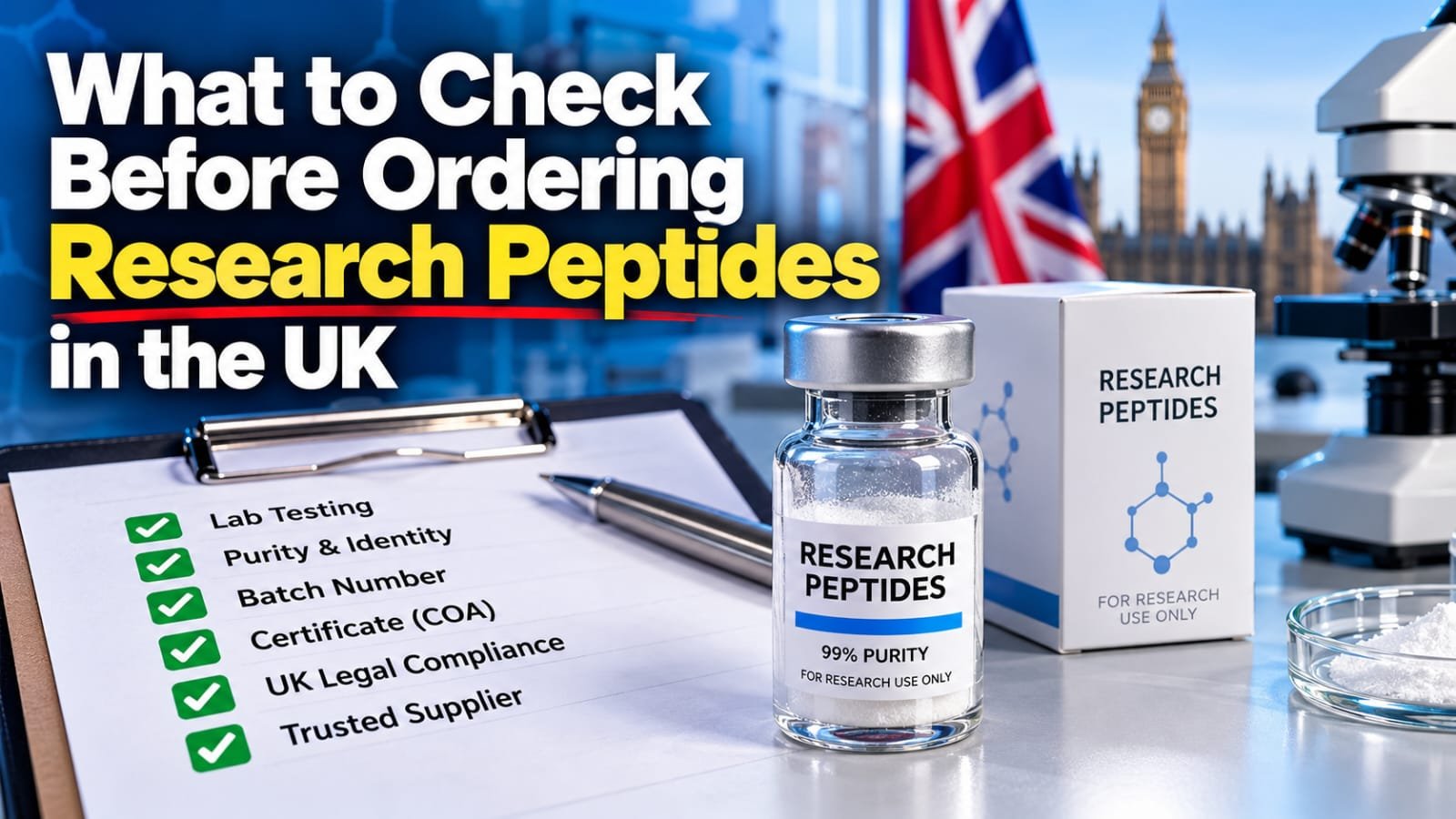
The safest way to choose a research peptide supplier is to check whether its test results match the exact vial being sold. A purity figure on a website means little unless it’s tied to a batch number, a named laboratory and a report that can be looked up. Anyone searching buy peptides uk will find dozens of shops with near identical claims. Most say “99% pure” and “lab tested,” and most make it hard to tell which ones can back that up.
Why Peptide Quality Is So Hard to Judge
Research peptides usually arrive as a small amount of white powder in a sealed glass vial. Nothing about that powder reveals what it is. A vial of the right compound at high purity looks exactly like a vial of the wrong compound, or the right one at half strength.
So everything rests on paperwork. A supplier either has testing that ties each batch to its results, or it doesn’t. Packaging, branding and website design say nothing about what’s inside.
The market adds to the problem. Many UK sellers buy from the same overseas manufacturers, relabel the stock and publish whatever certificate came with it. Some of those certificates are genuine. Others are years old, belong to a different batch or were never issued by a real lab at all.
Purity and Identity Are Two Different Tests
Two tests matter most, and they answer different questions.
HPLC, or high performance liquid chromatography, measures purity. It shows how much of the sample is the main compound and how much is something else. A result of 98% means roughly 2% of the powder is impurities, fragments or leftover material from synthesis.
Mass spectrometry confirms identity. It checks the molecular weight of the compound against what it should be. A sample can be 99% pure and still be the wrong peptide, which is why HPLC alone isn’t enough.
A useful certificate shows both. It names the lab that ran them and gives a report number that can be checked with that lab directly.
Batch Numbers and Reused Certificates
Matching the batch number is the step most buyers skip. Each vial should carry a batch number on its label. The certificate on the website should show the same number. If they don’t match, the certificate describes some other vial.
Warning signs worth watching for include the following.
- A certificate with no batch number at all
- The same certificate shown for several different batches or products
- A report dated years before the product went on sale
- No laboratory name, or a lab that can’t be found online
- A report number the issuing lab doesn’t recognise
- Purity figures that are suspiciously identical across every product
Careful suppliers publish each batch’s figure as measured, even when it comes in slightly below their usual specification. That kind of honesty is a better sign than a wall of perfect 99.9% results.
The Legal Line in the UK
Research peptides occupy a narrow legal space in the UK. Most aren’t controlled drugs, so buying and selling them for laboratory research is generally lawful. None of them are licensed medicines, though. Under UK medicines law, selling an unlicensed product with claims that it treats, prevents or cures anything can be an offence.
That’s why reputable suppliers sell strictly for in vitro research. They ask buyers to confirm they’re over 18 and buying for research purposes, and they avoid health claims entirely. A seller that makes medical promises, or markets products for human use, is ignoring the rules. Whatever else it ignores is anyone’s guess.
Anyone considering a buy peptides uk search for a lab project should check the current legal position for the specific compound. Rules can change, and a few peptides are subject to specific warnings from regulators.