

Businesses that sell, write about, or market peptides face a simple but serious question: what can they actually say? The Tesamorelin peptide has one approved medical use in the United States, yet online claims stretch far beyond it. That gap creates real risk for any company publishing product pages, blog posts, or ads.
Most people searching this topic want a clear dividing line. They’re asking which uses are backed by regulators, which are still being studied, and which have no solid evidence at all.
Confusion starts when those three categories blur together. A single small study gets quoted as proof. A research product gets described with medical benefits. Before long, a business is making claims it can’t support.
Why Clear Categories Matter?
Regulators judge claims by evidence and approval status, not by popularity. Sorting every claim into a clear category protects both customers and the business.
- Approved uses have regulator sign-off for a specific group.
- Investigational uses are being studied but aren’t approved.
- Unsupported claims lack meaningful clinical evidence.
- Research use only products can’t carry medical claims.
- Rules differ between the US, UK, and EU.
Know the Approved Use
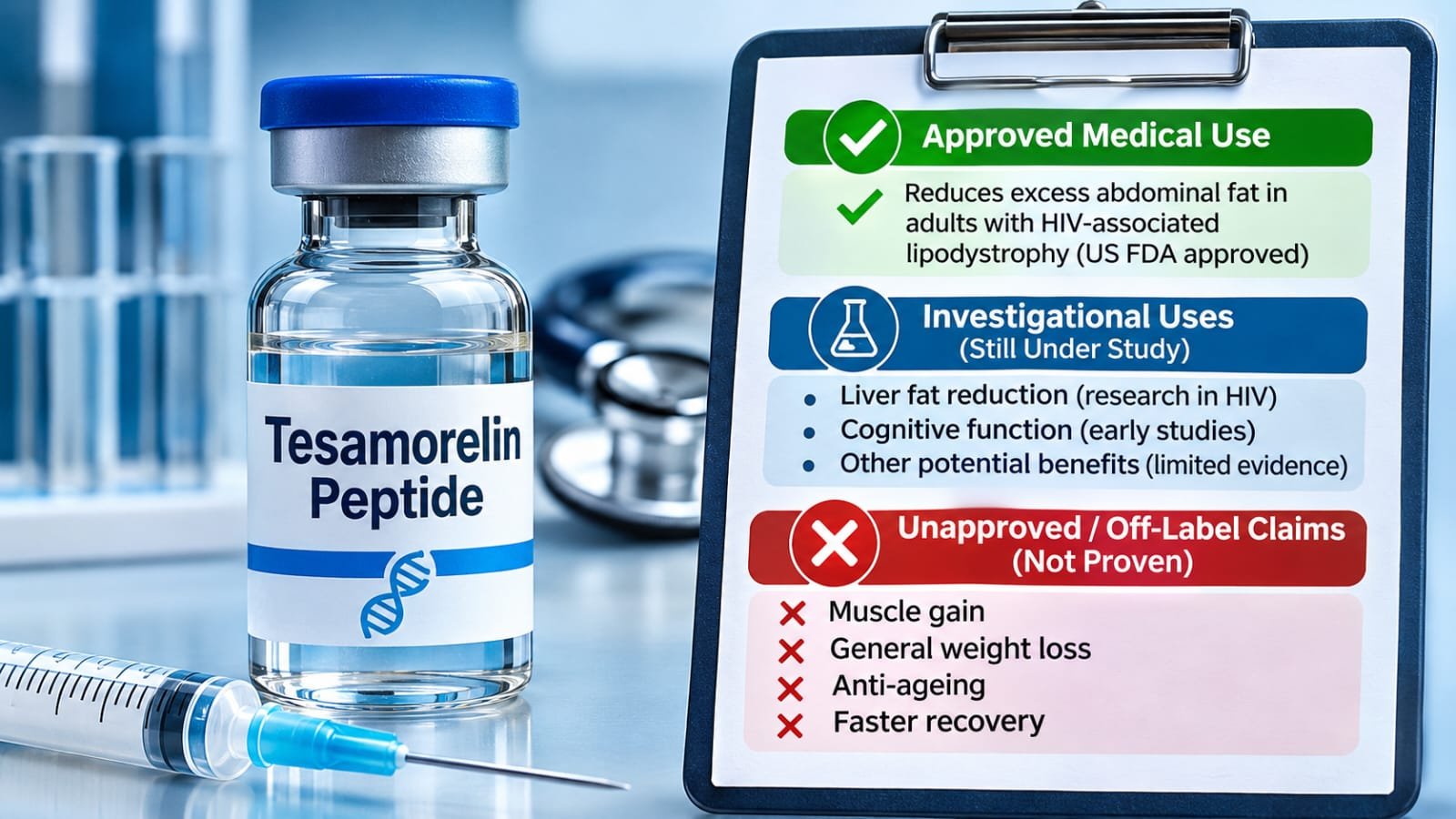
In November 2010, the US FDA approved tesamorelin for one purpose: reducing excess abdominal fat in adults with HIV who have lipodystrophy. Approval followed two phase 3 trials involving more than 800 participants. Visceral fat dropped by roughly 15 to 18 percent over 26 weeks. One limitation matters here. Fat tended to return once treatment stopped, so results depended on continued use.
Understand the Investigational Areas
Researchers have studied the Tesamorelin peptide beyond its approved use. A trial published in 2019 looked at liver fat in people with HIV and found meaningful reductions. Another study in 2012 examined cognitive function in older adults. These results are worth following, but they don’t create approved uses. Most studies remain small, short, or limited to narrow groups.
Spot the Unsupported Claims
Marketing online often links tesamorelin to muscle gain, general weight loss, anti-ageing, or faster recovery. None of these has regulatory approval. Few have strong clinical evidence in healthy adults. Repeating them on a product page can mislead customers. It can also attract enforcement action from regulators.
Check Regional Rules
Status varies by country. The European Medicines Agency declined to approve tesamorelin in 2013. In the UK, it isn’t licensed as a medicine. The MHRA regulates medicines there, while advertising rules set by the CAP Code prohibit promoting unlicensed medicines to the public. The difficulty is that rules sit across several bodies, so compliance needs regular checking.
Separate Research Products from Medicines
Many UK suppliers sell peptides labelled “research use only.” That label only holds up if marketing matches it. Pages that describe human benefits, dosing or results for personal use undermine the label entirely. Some businesses add disclaimers while still making health claims nearby, which rarely satisfies regulators.
Action Plan
- Audit every product page, blog post, and ad for health claims.
- Sort each claim into approved, investigational, or unsupported.
- Remove unsupported claims completely.
- Describe investigational research as early findings with sources.
- Keep research-use-only pages free of human benefit language.
- Link to primary sources such as PubMed or regulator websites.
- Review content every six months as rules change.
Reality Check
Most businesses don’t set out to mislead. They copy competitor wording or repeat claims that seem common. That’s where trouble starts. Popular claims aren’t the same as proven ones.
Conditions also shift. New studies appear, approvals change, and advertising enforcement tightens. A page that seemed fine two years ago may now breach current rules. Honest businesses still get caught when they don’t revisit older content.
Building Lasting Compliance
Treat claim review as a routine process rather than a one-time fix. Keep a simple log of every claim, its source, and the date it was checked. Assign one person to track regulatory updates from the FDA, MHRA, and ASA. Over time, that steady habit builds credibility with customers and reduces legal risk far more than occasional clean-ups.
Frequently Asked Questions
- What is tesamorelin approved for?Reducing abdominal fat in adults with HIV associated lipodystrophy, in the US.
- Is it licensed in the UK?No. It isn’t licensed as a medicine there.
- Can suppliers mention liver or brain research?Only as early findings with clear sources, not as proven benefits.
- Does a disclaimer allow health claims?No. Disclaimers don’t cancel misleading statements nearby.
- How often should content be reviewed?At least every six months, or whenever regulations change.
Clear, accurate claims aren’t about saying less. They’re about saying only what the evidence supports. Businesses that sort claims carefully, cite real sources, and review content regularly will build more trust than those chasing bold promises.