

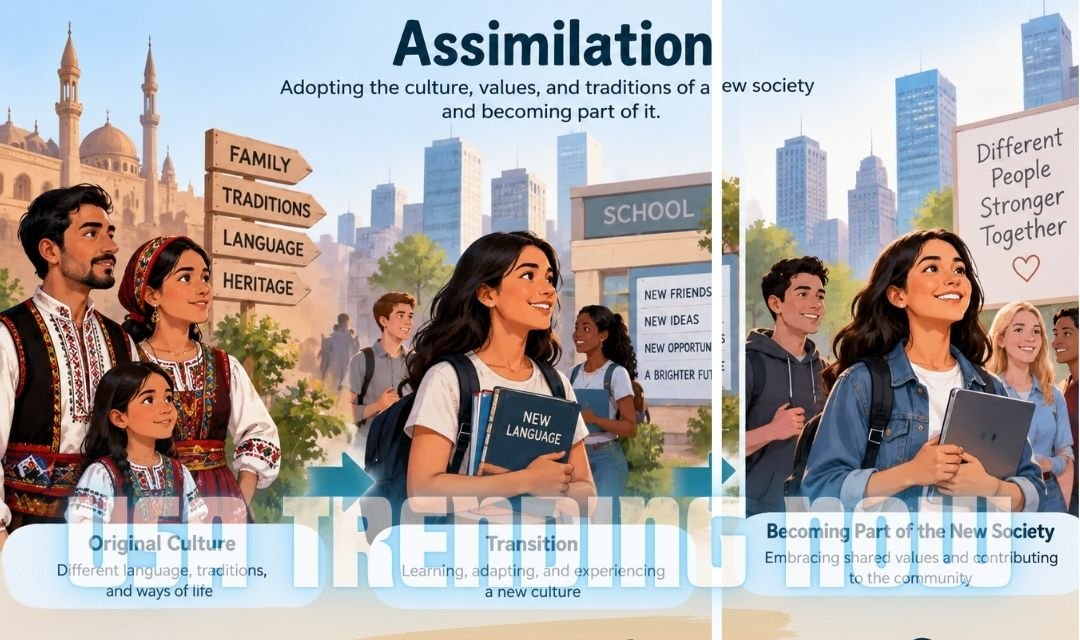
Assimilasjon is a Norwegian word meaning assimilation—the process in which something becomes more similar to, or is absorbed into, something that already exists. The official Norwegian dictionary Ordbøkene.no definition of assimilasjon explains that the word can describe cultural change, language sounds, psychology, biology, geology and several other fields. In society, assimilasjon often describes a minority group gradually becoming more similar to the majority by adopting its language, customs or cultural practices.
Quick Facts About Assimilasjon
| Detail | Information |
|---|---|
| Word | Assimilasjon |
| Language | Norwegian |
| English Meaning | Assimilation |
| Word Type | Noun |
| Norwegian Gender | Masculine |
| Origin | Latin |
| Main Basic Meaning | Becoming similar to or being absorbed into something |
| Cultural Meaning | Minority adopts characteristics of majority culture |
| Language Meaning | One speech sound becomes more like another |
| Psychology Meaning | New information is fitted into existing knowledge |
| Biology Meaning | Materials are absorbed and converted into parts of an organism |
| Geology Meaning | Surrounding rock becomes incorporated into magma |
| Opposite Term | Dissimilasjon in some contexts |
| Commonly Confused With | Integration, adaptation and acculturation |
The Norwegian Bokmål Dictionary defines assimilasjon both as adaptation or transformation into something already existing and as a process through which a minority becomes more similar to a majority.
What Does Assimilasjon Mean?
The easiest way to understand assimilasjon is to think about the word “becoming more alike.”
Imagine two groups of people.
One group is much larger and has its own:
language,
traditions,
clothing,
food,
customs,
and social rules.
A smaller group moves into that society.
Over time, members of the smaller group may begin speaking the majority language.
They may follow more of the majority’s customs.
Some older traditions may slowly disappear.
That process can be described as cultural assimilation.
But that is only one meaning.
Assimilasjon also appears in science, language and psychology.
The exact meaning therefore depends on the subject being discussed.
Where Does the Word Assimilasjon Come From?
The Norwegian word comes ultimately from Latin.
Norwegian dictionaries trace it to Latin assimilatio, connected with the idea of making something similar.
That origin fits almost every modern use.
In language, one sound becomes similar to another.
In culture, one group becomes more similar to another.
In psychology, new information is made to fit what a person already understands.
In biology, substances become incorporated into living material.
The exact process changes.
The basic idea stays similar.
Assimilasjon in Society and Culture
This is probably the most important meaning for readers studying history or sociology.
Cultural assimilation happens when a minority group becomes increasingly similar to the dominant culture.
This can involve changes in:
language,
religious practices,
clothing,
food,
names,
family traditions,
education,
and social behavior.
Sometimes this happens naturally over several generations.
People move.
Children attend local schools.
Families learn the majority language.
Friendship and marriage connect different groups.
Cultural habits slowly mix.
But assimilation can also be encouraged or forced by governments.
That is where the subject becomes much more serious.
Voluntary Assimilation
Not all assimilation is forced.
Imagine a family moving to another country.
The parents may decide to learn the local language because they want better jobs.
Their children may speak that language at school.
The family may celebrate some local holidays.
They may begin eating local foods.
At the same time, they might continue speaking their original language at home and celebrating older family traditions.
Some changes are simply practical.
This can be described as a form of voluntary cultural adaptation or assimilation.
However, complete assimilation would normally involve much stronger loss of the original culture.
Forced Assimilation
Forced assimilation is very different.
This happens when authorities pressure minority communities to abandon important parts of their identity.
A government might discourage or prohibit:
a minority language,
traditional clothing,
religious customs,
names,
education systems,
or cultural practices.
Children may be educated only in the majority language.
People may be punished or disadvantaged for keeping their original traditions.
In these situations, assimilation is not simply about people adapting naturally.
It becomes a political policy.
The official Norwegian dictionary specifically uses the historical fornorsking of the Sami as an example when explaining assimilation.
Assimilasjon and the Sami People
Norway provides an important historical example of assimilation.
For a long period, Norwegian authorities pursued policies designed to make Indigenous Sami communities and other minorities more similar to the Norwegian-speaking majority.
Language was one of the most important areas.
Norwegian became dominant in schools and public institutions.
Minority languages and identities were often discouraged.
The Norwegian Academy Dictionary notes that from the late 19th century, policy aimed at language change and extensive assimilation of Sami and Kven communities.
Today this history is discussed very differently.
There is much greater recognition that language and culture are important parts of people’s identity and should not simply be erased.
Assimilation vs. Integration
These words are often confused.
But they do not mean exactly the same thing.
Assimilation
The minority changes to become more like the majority.
Think:
“You become like us.”
Integration
People become part of the wider society while still being able to keep important parts of their original culture.
Think:
“You can be part of us while still being yourself.”
That is a simplified explanation, but it shows the main difference.
The Norwegian dictionary description of assimilation emphasizes a process where minorities become similar to the majority.
A Simple Assimilation Example
Imagine a family moving from Country A to Country B.
The parents speak Language A.
Their children begin school in Language B.
At home, everyone initially speaks Language A.
Twenty years later, the children mostly speak Language B.
Their own children know only a few words of Language A.
Traditional celebrations from Country A become less common.
Family names may even be changed to fit local pronunciation.
That is a common example of assimilation across generations.
The family has become much more culturally similar to the majority population of Country B.
Does Assimilation Always Mean Losing Everything?
No.
Assimilation is not always complete.
People can adopt some things while keeping others.
For example, someone might:
speak the majority language at work,
speak another language at home,
eat food from both cultures,
celebrate holidays from both traditions,
and identify with both communities.
Human identity is complicated.
Cultures do not usually operate like an on/off switch.
That is why researchers may use terms such as:
partial assimilation,
integration,
acculturation,
multiculturalism,
or bicultural identity.
Assimilasjon in Language
The word has a completely different technical meaning in linguistics.
In language science, assimilation happens when one speech sound becomes more like another nearby sound.
Store norske leksikon explains that one sound can influence another until the two become partially or completely alike.
Why does this happen?
Because speaking is fast.
Your tongue, lips and other speech organs are constantly moving.
When one sound is followed immediately by another, your mouth may begin preparing for the second sound before the first is completely finished.
That can change pronunciation.
Contact Assimilation
When the two sounds are next to each other, linguists call it contact assimilation.
A sound is influenced by the sound immediately beside it.
Store norske leksikon gives the historical development from Old Norse vatn toward Norwegian vann as an example of assimilation in language change.
This kind of change can happen naturally.
Nobody sits down and decides:
“Today we will assimilate these two sounds.”
Speakers simply pronounce words in an easier or more natural way.
Over generations, pronunciation can permanently change.
Distant Assimilation
Sounds do not always need to be directly beside each other.
Sometimes a sound influences another sound farther away in the same word.
This is called distant assimilation, or fjernassimilasjon in Norwegian linguistic terminology.
Store norske leksikon distinguishes this from contact assimilation.
Again, the central idea is similarity.
One sound becomes more similar to another.
Regressive Assimilation
Another language term is regressive assimilation.
Here, a later sound affects the sound before it.
Imagine your mouth already preparing for the next sound.
That preparation changes how you pronounce the current sound.
This is extremely common in natural speech.
Most speakers perform sound changes without even realizing it.
Why Assimilation Makes Speech Easier
Try speaking very slowly.
Every sound can be pronounced clearly.
Now speak quickly.
Sounds begin to blend.
Your mouth wants efficiency.
Instead of completely finishing one movement and then beginning another, the movements overlap.
This process is called coarticulation, and Store norske leksikon explains that assimilation develops partly because speech organs remain in continuous motion during natural speech.
That is why linguistic assimilation is completely normal.
It exists in languages around the world.
Assimilasjon in Psychology
Psychology gives the word another interesting meaning.
Here, assimilation can describe the way people understand new experiences through ideas they already have.
The concept is especially associated with psychologist Jean Piaget and his theory of cognitive development.
Store norske leksikon explains that children assimilate new experiences by connecting them with knowledge and experiences they already possess.
Here is a simple example.
A small child knows what a dog is.
The child sees a wolf for the first time.
They shout:
“Dog!”
Why?
Because the new animal has been fitted into an existing mental category.
That is psychological assimilation.
Assimilation and Accommodation in Psychology
Piaget also used another important idea:
accommodation.
Assimilation means fitting something new into an existing mental idea.
Accommodation means changing the mental idea because the new information does not fit properly.
Using the earlier example:
Child sees wolf.
Child says, “Dog.”
That is assimilation.
Parent explains that it is a wolf.
The child learns that dogs and wolves are different.
Their mental categories change.
That is accommodation.
Learning involves both processes.
Assimilasjon in Biology
Assimilation also appears in biology.
Here it refers to organisms taking substances and transforming them into materials they can use.
The Norwegian Academy Dictionary describes biological assimilation as the transformation of absorbed nutrients into parts of cells and tissues.
Think about eating food.
Your body does not simply place a sandwich directly into your muscles.
Food is broken down.
Nutrients are absorbed.
Those nutrients are processed and used to create or maintain living tissue.
That is one biological form of assimilation.
Assimilation in Plants
Plants provide another example.
They take in substances such as carbon dioxide.
Through processes including photosynthesis, these materials can be transformed into organic compounds such as sugars.
Norwegian dictionary sources specifically use the assimilation of carbon dioxide as an example of the scientific meaning of the word.
Again, something is being taken in and turned into part of an existing system.
Assimilasjon in Geology
Yes, geologists use the word too.
In geology, assimilation can happen when surrounding rock is incorporated into molten material such as magma.
The Norwegian Academy Dictionary defines geological assimilation as the dissolution of nearby or enclosed rock into magma.
Imagine extremely hot molten rock moving through the Earth’s crust.
It touches another type of rock.
Some of that surrounding rock melts or dissolves into the magma.
The magma’s composition can then change.
That process can be called assimilation.
Why One Word Has So Many Meanings
At first, this can seem confusing.
How can the same word describe:
immigration,
language pronunciation,
children learning,
plants,
digestion,
and volcanoes?
Because every meaning contains the same basic pattern.
Something new comes into contact with something already existing.
Then it becomes similar to or part of that existing system.
That basic idea works in many different subjects.
Assimilation and Identity
The cultural meaning deserves special care because it deals with real people.
Culture can include:
language,
family history,
religion,
music,
traditional knowledge,
food,
stories,
and community belonging.
When a group loses these things because people freely adopt a different culture, the process can already be emotionally complicated.
When those changes result from discrimination or government pressure, the consequences can last for generations.
That is why modern discussions of forced assimilation frequently focus on:
human rights,
minority languages,
Indigenous identity,
education,
and historical justice.
Can Assimilation Happen Across Generations?
Yes.
In fact, cultural assimilation often happens slowly.
The first generation may strongly preserve the original language.
The second generation may speak both languages.
The third generation may mainly use the majority language.
After several generations, only small cultural traditions may remain.
This is not guaranteed.
Some communities preserve language and identity for hundreds of years.
Others change relatively quickly.
Many factors influence the process.
What Causes Cultural Assimilation?
There is no single cause.
Important factors can include:
migration,
education,
employment,
marriage,
media,
urbanization,
government policy,
discrimination,
language pressure,
economic opportunity,
and social acceptance.
Sometimes assimilation happens because people believe adopting majority customs will create better opportunities.
Sometimes it happens because maintaining minority identity is made difficult.
And sometimes cultures simply mix naturally.
Is Assimilation Good or Bad?
There is no single answer because the word describes many different situations.
Linguistic assimilation is a normal part of speech.
Biological assimilation is necessary for life.
Psychological assimilation is part of learning.
Cultural assimilation is more complicated.
Voluntary cultural change can be part of migration and everyday social life.
Forced cultural assimilation can damage languages, identities and communities.
The key questions are:
Was the change voluntary?
Did people have a real choice?
Were minority languages respected?
Were people punished for their identity?
Those questions make a major difference.
Assimilasjon vs. Acculturation
Another word you may see is acculturation.
Acculturation generally describes cultural change caused by contact between groups.
Both groups can influence each other.
Assimilation usually suggests something stronger.
One group becomes increasingly similar to another, often the dominant group.
So:
Acculturation = cultures influence each other.
Assimilation = one group increasingly resembles another.
The exact definitions can differ slightly between academic fields, but this distinction is useful for beginners.
Assimilasjon vs. Multiculturalism
Multiculturalism takes a different approach.
Instead of expecting everyone to become culturally alike, multicultural societies accept that people can share a country while maintaining different:
languages,
religions,
traditions,
foods,
and identities.
For example, one city may contain communities from many backgrounds.
They participate in the same economy and legal system.
But they do not need to become culturally identical.
That idea contrasts with strong assimilation models.
Why People Search for Assimilasjon
The keyword appears in several different types of searches.
Students may encounter it in:
Norwegian-language lessons,
history,
social studies,
psychology,
biology,
geology,
or linguistics.
Others may encounter the term while studying Sami history and Norwegianization.
A person translating Norwegian into English may simply want to know:
“What does assimilasjon mean?”
That is why search results can initially look confusing.
One page discusses language sounds.
Another discusses minorities.
Another discusses plants.
They are all using the same word correctly—but in different academic fields.
What Is the Simplest Definition of Assimilasjon?
If you need only one sentence, use this:
Assimilasjon means a process in which something becomes more like, or becomes incorporated into, something already existing.
Then look at the context.
If the topic is people, it probably means cultural assimilation.
If the topic is pronunciation, it means sound assimilation.
If the topic is children and learning, it probably means psychological assimilation.
If the topic is plants or the human body, it probably means biological assimilation.
What We Actually Know About Assimilasjon
The term is a standard Norwegian word.
Its English translation is assimilation.
The official Norwegian dictionaries trace it to Latin and define it broadly as adaptation or transformation into something already existing.
They also specifically use it for a process where minority groups become more similar to the majority.
In linguistics, assimilation means one speech sound becomes fully or partly like another.
In psychology, the term can describe understanding new experiences through previously developed mental structures.
In biology and physiology, it involves absorbing and transforming substances into living material.
And in geology, it can describe surrounding rock becoming incorporated into magma.
So assimilasjon is not one mysterious internet term.
It is a real academic and everyday Norwegian word with several related meanings.
Final Thoughts
Assimilasjon looks complicated because it appears in so many subjects.
But the basic idea is easy.
Something becomes more similar to something else.
In society, a minority can become more similar to the majority.
In language, one sound becomes more like another.
In psychology, a new experience is fitted into knowledge already stored in the mind.
In biology, nutrients or other substances are transformed and incorporated into living material.
In geology, surrounding rock can become part of magma.
The cultural meaning is the one that usually requires the most careful discussion.
Assimilation can happen naturally when people live together and cultures change.
But governments have also used assimilation policies to pressure minority and Indigenous communities to abandon their languages and traditions.
Norwegian dictionary sources themselves use the historical Norwegianization of the Sami as an example.
That history shows why the difference between integration and assimilation matters.
Integration can allow people to participate fully in society while maintaining important parts of their identity.
Strong assimilation can demand that those differences disappear.
For readers searching for “assimilasjon meaning,” the clearest answer is:
Assimilasjon is the Norwegian word for assimilation—a process through which something becomes similar to, or is incorporated into, something that already exists. Its exact meaning depends on whether the topic is culture, language, psychology, biology or another field.
Frequently Asked Questions About Assimilasjon
What does assimilasjon mean?
Assimilasjon is the Norwegian word for assimilation. It generally means becoming more similar to, adapting to, or being incorporated into something already existing.
Is assimilasjon a Norwegian word?
Yes. It is used in both Norwegian Bokmål and Nynorsk.
What is cultural assimilasjon?
Cultural assimilation happens when a minority group becomes increasingly similar to the majority culture, often by adopting its language, customs or other cultural characteristics.
Is assimilation the same as integration?
No. Assimilation usually involves becoming more like the majority, while integration can allow people to participate in society while keeping important parts of their own culture.
What is forced assimilation?
Forced assimilation happens when governments or institutions pressure people to give up their language, customs or identity in favor of the dominant culture.
Did Norway have assimilation policies?
Yes. Norwegianization policies historically pressured Sami and other minority communities to adopt Norwegian language and culture. Norwegian dictionary sources use this history as an example of assimilation.
What does assimilasjon mean in linguistics?
It means one speech sound becomes partially or completely similar to another sound.
What is contact assimilation?
It happens when two sounds that are directly beside each other influence one another.
What is distant assimilation?
It occurs when one speech sound influences another even though other sounds occur between them.
Why does sound assimilation happen?
Speech organs continuously move while we talk, causing sounds to overlap and influence one another.
What is assimilation in psychology?
In psychology, assimilation can mean fitting new experiences into mental ideas or knowledge structures that already exist.
What is an example of psychological assimilation?
A child who knows dogs may initially call a wolf a dog because the new animal is being fitted into an existing mental category.
What is assimilation in biology?
It can refer to absorbed substances being transformed into materials that become part of cells, tissues or an organism.
What is assimilation in plants?
Plants can assimilate substances such as carbon dioxide and transform them into organic material during processes connected with photosynthesis.
What does assimilation mean in geology?
It describes surrounding or enclosed rock becoming dissolved or incorporated into molten magma.
What is the opposite of assimilasjon?
In some linguistic and technical contexts, the opposite is dissimilation, where things become less similar rather than more similar. The Norwegian dictionary explicitly notes dissimilasjon as an opposite.
Is assimilation always forced?
No. Cultural assimilation can happen voluntarily, naturally or through social interaction. It can also be politically encouraged or forced.
Is assimilation always bad?
No. The answer depends on context. Linguistic, psychological and biological assimilation are normal processes. Forced cultural assimilation can create serious human-rights and cultural-loss concerns.
Can a person be part of two cultures?
Yes. People can maintain parts of their original culture while also participating fully in another society. This is often discussed through ideas such as integration and bicultural identity rather than complete assimilation.
What is the easiest definition of assimilasjon?
Assimilasjon means becoming more similar to or becoming part of something that already exists.
For more trending terms, educational explainers and easy-to-understand guides, visit USA Trending Now.