

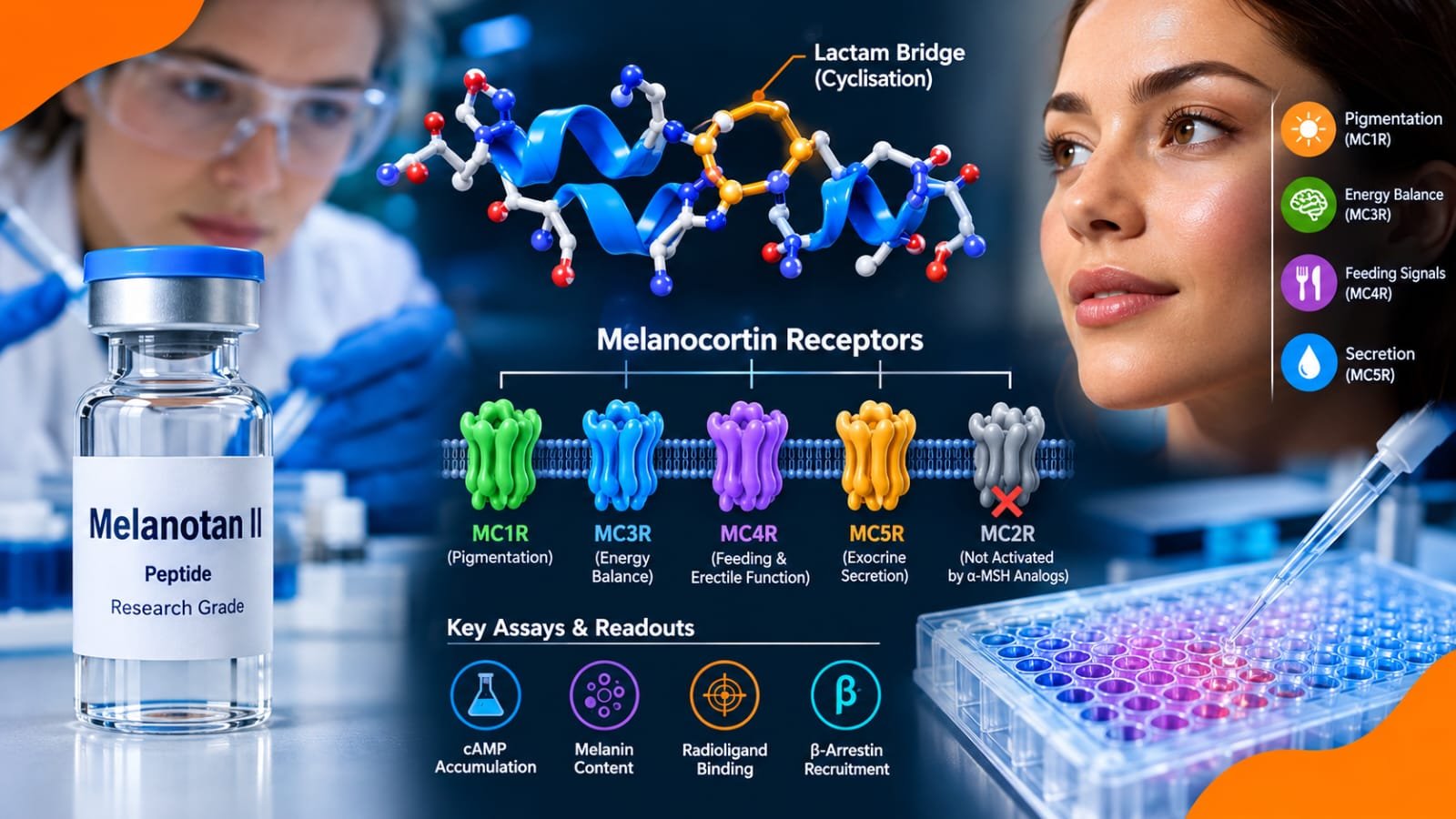
Receptor selectivity separates melanocortin analogues more than raw potency. Melanotan II activates four of five known subtypes. Breadth like that shapes every assay built around it. Laboratories sourcing MT2 peptide UK stock weigh affinity data first. This analysis covers subtype coverage and the structural source of potency. Control selection, handling variables, and comparator peptides follow.
Four Subtypes Respond To One Ligand
MC1R, MC3R, MC4R and MC5R all respond. MC2R stays outside the picture, since ACTH alone triggers it. Potency sits in the sub-nanomolar range across several cell-based readouts. Such breadth delivers a tool and a complication at once. Pigment assays and feeding studies draw on one molecule. Planning for overlap protects the eventual interpretation.
Why Does The Lactam Bridge Matter?
Cyclisation locks the backbone into a β-turn. A lysine side chain joins an aspartate carboxyl. Rigidity slows proteolysis and extends residence at the target. Linear versions of the same sequence bind weakly. Structure, not sequence alone, drives potency. Picture a folded paperclip holding shape under pressure. The ring does comparable work chemically.
Tissue Distribution Guides Experimental Endpoint Choice
Each subtype occupies distinct tissue, so endpoints diverge. Purity figures for MT2 peptide UK material aid cross-assay comparison.
- MC1R drives eumelanin output in cultured melanocytes
- MC3R modulates energy balance in hypothalamic tissue
- MC4R governs feeding signals and erectile pathways
- MC5R supports secretion in exocrine gland models
Endpoint choice follows tissue, never convenience.
How Should Controls Be Chosen Here?
Non-selectivity makes a single readout hard to interpret. SHU9119 blocks MC3R and MC4R, isolating pigmentation effects. Afamelanotide gives an MC1R-preferring comparator in parallel wells. Vehicle-only plates catch drift in cAMP accumulation. Paired antagonist runs convert ambiguous curves into attributable signals. Absent that pairing, attribution rests on assumption.
What Undermines Reproducibility In These Assays?
Four variables account for most disputed numbers. Nanomolar comparisons collapse under careless handling.
- Lyophilised powder absorbs moisture quickly
- Repeated freeze-thaw cycles reduce potency
- Receptor expression drifts across HEK293 passages
- Buffer pH alters apparent binding
- Light exposure degrades stored solutions
Logging each step rescues otherwise sound datasets.
Binding Data Needs Functional Confirmation
Competition binding gives IC50 values, nothing more. Occupancy and activation are separate phenomena. A ligand may dock firmly yet trigger little cAMP. Functional assays in HEK293 lines settle the question. Melanotan II clears both bars, which explains its benchmark status. Reporting affinity without efficacy leaves the record incomplete.
Which Readouts Capture Downstream Signalling Best?
cAMP accumulation remains the primary signal for melanocortin targets.
- Forskolin-stimulated plates establish the upper boundary of response
- β-arrestin recruitment assays expose biased signalling at MC4R
- Melanin content readings confirm pigment output in melanocytes
- Radioligand displacement anchors potency against a known standard
Two orthogonal readouts beat one crowded dataset.
MC2R’s Silence Carries Its Own Lesson
ACTH alone opens MC2R, and the exclusion instructs. Selectivity here arises from the binding site, not the ligand. Bremelanotide emerged by narrowing the same scaffold toward MC4R. A four-target compound works best as a reference standard. Precision belongs to its narrower descendants.
FAQs
Does Melanotan II favour any one subtype?
Affinity stays broadly comparable across MC1R, MC3R, MC4R and MC5R. No meaningful preference emerges, which is precisely why it serves as a non-selective benchmark in pharmacology work.
Why exclude MC2R from binding panels?
MC2R answers to ACTH rather than α-MSH analogues. Including it adds cost without adding signal, so most published panels omit the subtype entirely.
What makes the cyclic form more stable?
The side-chain lactam restricts backbone rotation and shields cleavage sites from enzymes. Longer half-life in assay buffer follows, alongside sharper dose-response curves.
Which comparator peptides sharpen interpretation?
Afamelanotide isolates MC1R-driven pigmentation, while SHU9119 silences MC3R and MC4R. Running both alongside the parent compound separates central from cutaneous readouts.