

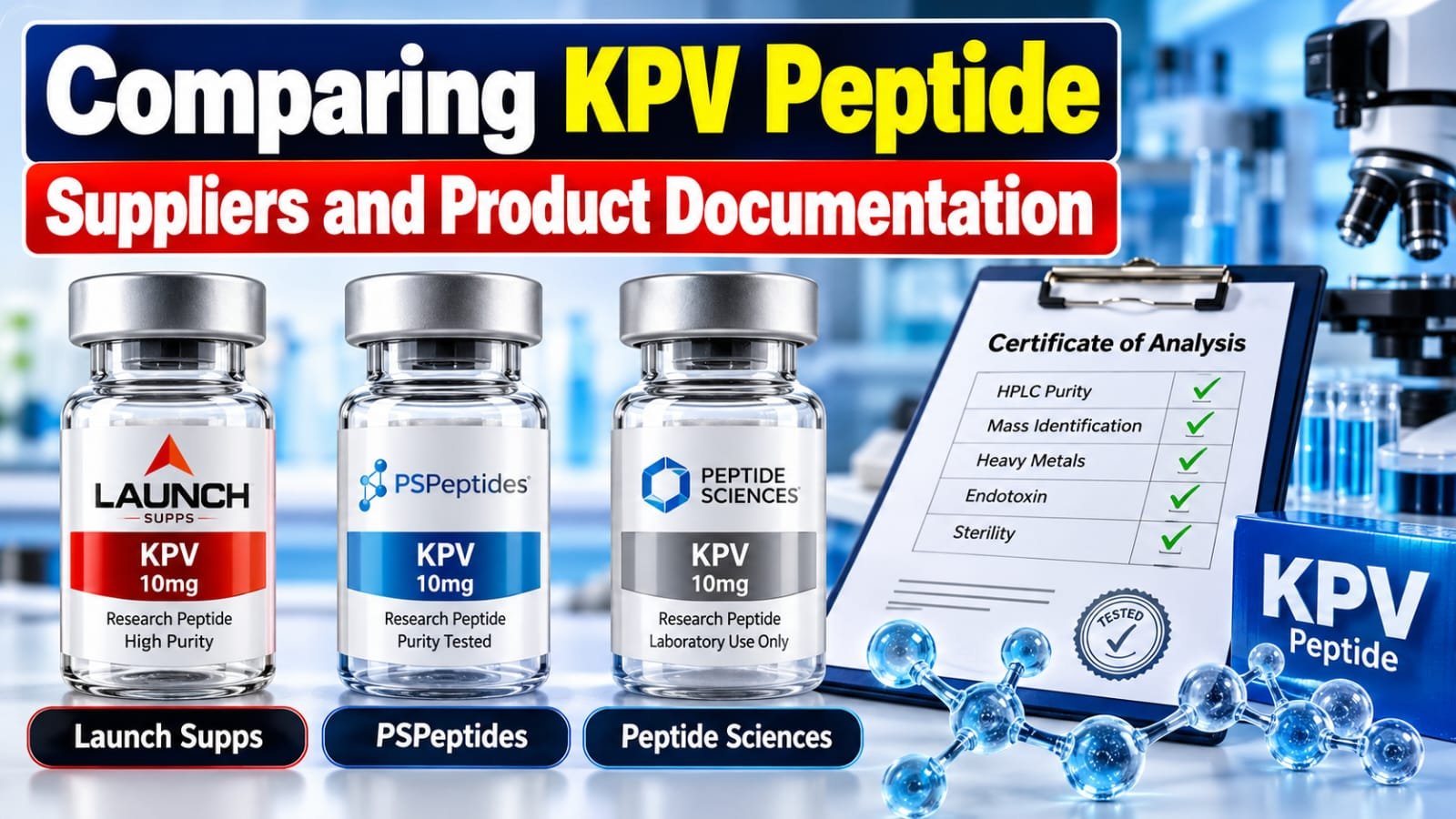
Finding a research peptide supplier involves more than checking a compound name and its stated strength. Researchers also look at product identification, available analytical records and the range of materials offered by a supplier. These details become particularly relevant when comparing individual KPV peptide listings with suppliers that cover several research-compound categories.
Launch Supps, PSPeptides and Peptide Sciences are names that may appear during this search, although their current offerings and operating arrangements differ. Looking at their published information helps clarify what researchers can check before deciding which supplier warrants further investigation.
Launch Supps
Launch Supps offers a dedicated KPV 10mg product listing within a broader catalogue of research compounds. Rather than beginning with a general category alone, visitors can go directly to the product page associated with the compound they want to investigate.
- Provides a dedicated listing for KPV with a stated strength of 10mg.
- Maintains a wider catalogue covering peptides, SARMs and combination stacks.
- Gives visitors individual product pages to examine specific compounds.
- States that its products undergo independent testing for purity and quality.
- Provides a starting point for checking product specifications and any supporting documentation available for the selected item.
- Connects individual product listings with the wider store, making it possible to explore related catalogue categories.
The broader catalogue is a useful part of the picture. Someone researching KPV may also be reviewing other peptide listings or trying to understand the difference between individual compounds and combination products. Having these categories within one store gives the researcher a clear starting point for that exploration.
For anyone evaluating the KPV peptide, this creates a straightforward review process. Begin with the dedicated product page, examine the available specifications, and check the supporting records rather than relying on general statements about research compounds. The same approach applies when exploring other products in the catalogue.
Launch Supps also gives researchers a broader store context beyond one product. That can be useful when the task involves comparing several catalogue categories, provided each compound is assessed individually and the supplier’s stated intended-use restrictions are followed.
PSPeptides
PSPeptides is another supplier associated with research peptides, including KPV. Its published certification pages provide a more specific point of reference for researchers who want to examine available analytical reports.
- Lists KPV among its research peptide products.
- Publishes third-party certificate-of-analysis information for KPV.
- Provides reports covering analytical areas such as HPLC purity and mass identification.
- Lists additional testing information for certain products, including heavy metals, endotoxin and sterility reports.
These records give researchers concrete material to review. The relevant report should still be checked for its batch identifier, date, methods and reported results, since testing information can vary between products and batches.
Peptide Sciences
Peptide Sciences is a name that appears in research peptide discussions and historical supplier comparisons. Its current official website states that public retail storefront operations have been discontinued.
- Maintains an official website for product verification and catalogue references.
- Provides information relating to brand protection and product authentication.
- Directs relevant enquiries through its official communication channels.
- Should be assessed according to its current operating status rather than older descriptions of its retail catalogue.
This distinction is useful when researching suppliers through older articles or third-party references. A name appearing in a comparison does not necessarily mean its former retail arrangements remain available.
What Matters When Comparing KPV Suppliers?
A useful comparison considers several details together rather than relying on a single purity figure or a general quality statement.
- Product identification: Check the exact compound name and stated strength.
- Batch information: Look for a batch or lot reference that connects the material to its records.
- Analytical testing: Establish what the reported methods actually measure.
- Documentation: Check whether a certificate of analysis relates to the product and batch under consideration.
- Intended use: Review supplier restrictions and applicable regulations before making a decision.
HPLC can be used to assess sample purity, while mass spectrometry can help confirm molecular identity. These methods provide different types of information, so one result should not be treated as proof of every quality characteristic.
Launch Supps provides a dedicated KPV 10mg listing within a wider research-compound catalogue. PSPeptides offers published KPV testing documentation that can be examined directly, while Peptide Sciences currently focuses on verification and reference information rather than operating as a public retail storefront.
For researchers who want to start with a specific product and then explore a broader range of compounds, the Launch Supps catalogue provides a practical starting point. Its individual product listings and wider category structure allow the research process to begin with a defined item rather than a general supplier search.
Frequently Asked Questions
What is KPV?
KPV is a short peptide sequence derived from the C-terminal region of alpha-melanocyte-stimulating hormone. It has been investigated in experimental research involving inflammatory signalling, but laboratory findings do not establish clinical effectiveness in people.
What does KPV 10mg mean?
The stated strength indicates the quantity represented by the product listing. The full product information and available analytical documentation should be reviewed to understand the material being offered.
Why should researchers check a certificate of analysis?
A certificate of analysis records the results of specified tests. Its value depends on the methods used, the results reported and whether the document corresponds to the relevant material or batch.