

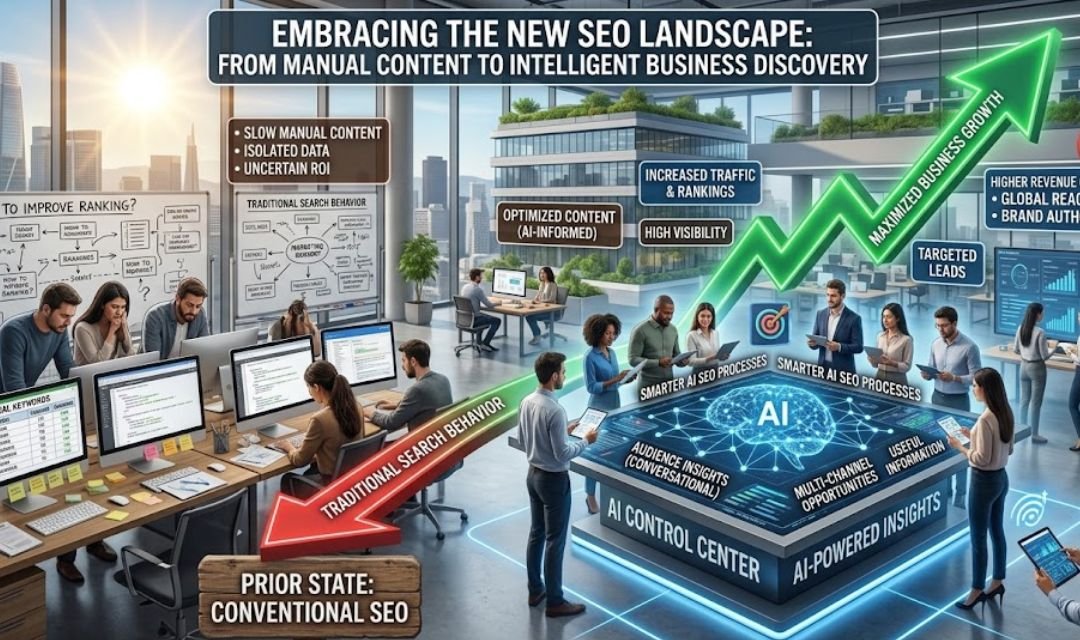
Search behaviour is becoming more conversational, and businesses are facing more ways to be discovered than traditional search results alone. For companies considering AI SEO services, the opportunity is not simply to use artificial intelligence for faster content production. It is to use smarter processes to understand audiences, identify opportunities and make online information more useful across changing search experiences.
AI can support many parts of an SEO programme, from research and content planning to performance analysis and workflow automation. However, the real value comes when these capabilities are combined with human expertise, reliable data and clear business objectives.
| Key Takeaways
● AI can help businesses analyse large amounts of search and website data more efficiently. ● Better audience insights can lead to more relevant content and stronger search strategies. ● Automation can reduce repetitive SEO work without removing human oversight. ● AI-supported optimisation can help businesses respond to changing search behaviour. ● The strongest results come from combining AI capabilities with expertise, accuracy and strategic judgement. |
Gain Deeper Insights Into Customer Search Behaviour
Understanding what customers want is one of the most important parts of SEO. Traditional keyword research can reveal what people search for, but businesses often need to go further to understand the questions and concerns behind those searches.
AI can help organise large sets of search queries, website data and customer questions into meaningful patterns. This gives marketing teams a broader view of how audiences move from initial research towards a decision.
Identify patterns across search queries
AI-assisted analysis can help businesses group related queries by themes, intent and customer needs.
This can reveal opportunities such as:
- Questions customers repeatedly ask
- Topics that competitors have covered poorly
- Differences between informational and commercial searches
- Content gaps across the website
- Emerging interests within a target audience
Instead of treating every keyword as an isolated opportunity, businesses can build a clearer picture of the topics that matter to their customers.
Develop More Relevant Content Ideas
Content planning can become difficult when a website has dozens or hundreds of existing pages. Teams may struggle to decide what to publish next, which pages deserve improvement or where two topics overlap.
Build content around customer needs
A useful content plan should answer practical questions rather than simply generate a long list of keywords.
Businesses can use AI-assisted research to explore:
- Common customer concerns
- Related questions around a service
- Topics that support purchasing decisions
- Missing information on existing pages
- Opportunities to refresh outdated material
The final content should still be reviewed by people with appropriate subject knowledge. AI can identify patterns, but experienced professionals are better placed to determine whether an idea is accurate, useful and relevant to the audience.
Make SEO Workflows More Efficient
SEO involves many repetitive activities, particularly when teams manage large websites. Tasks such as sorting keywords, checking page information, categorising content and preparing initial reports can consume considerable time.
AI can help streamline these workflows when used with appropriate checks. The objective is not to remove people from the process, but to reduce manual effort so specialists can focus on higher-value decisions.
Automate repetitive tasks carefully
Depending on the business and its technology stack, AI can support tasks such as:
- Categorising search terms
- Grouping similar content topics
- Identifying potential duplicate pages
- Summarising performance data
- Creating initial content briefs
- Highlighting unusual traffic patterns
- Supporting large-scale website analysis
Automation should always include validation. A faster process is only useful when the information produced is accurate enough to support sound decisions.
Improve Content Quality Through Better Analysis
AI can also help teams examine content from different perspectives. Rather than asking whether a page contains a particular keyword, businesses can assess whether the page actually answers the questions visitors are likely to have.
This creates an opportunity to improve existing content rather than constantly producing new pages.
Find opportunities inside existing pages
A content review can examine whether a page:
- Clearly addresses its main topic
- Answers important related questions
- Provides enough context
- Uses logical headings
- Links to relevant resources
- Contains outdated information
- Offers a clear next step for the reader
Refreshing a useful existing page can sometimes be more valuable than creating another article on a similar subject. Businesses should therefore consider content improvement as an ongoing part of SEO management.
Respond Faster to Changes in Search Behaviour
Search trends can shift because of new technologies, changing customer expectations, seasonal demand or developments within an industry. Businesses that identify these changes early have more time to adjust their content and priorities.
Use signals to guide strategic decisions
Businesses can compare current and historical information to identify changes in:
- Search demand
- Content engagement
- Landing-page performance
- Customer questions
- Branded searches
- Conversion behaviour
These signals should be interpreted alongside industry knowledge. A sudden change in traffic does not automatically mean a particular strategy has succeeded or failed; businesses need to investigate the reasons behind the movement.
Support Personalised Customer Journeys
Different visitors can arrive at the same website with completely different needs. One person may be researching a problem, another may be comparing providers, while someone else may already be ready to make contact.
AI-supported analysis can help businesses understand these different stages and develop content that addresses them more effectively.
Connect content with decision stages
A useful content journey may include:
| Customer Stage | Useful Content |
| Awareness | Educational guides and explanations |
| Research | Comparisons, examples and detailed resources |
| Evaluation | Service information, case studies and evidence |
| Decision | Pricing information, FAQs and clear contact options |
| Retention | Support resources and helpful follow-up content |
This approach helps businesses avoid publishing disconnected articles. Instead, each piece of content can have a clear role within the wider customer journey.
Strengthen Decision-Making With Data
One of the practical advantages of AI is its ability to process information at scale. For businesses managing multiple websites, markets or service categories, this can make it easier to identify trends that may be difficult to spot manually.
However, data should support decisions rather than make decisions automatically.
Turn information into useful recommendations
An effective analysis should answer practical questions such as:
- Which pages deserve attention first?
- Where are users dropping out?
- Which topics attract relevant visitors?
- Which content contributes to enquiries or sales?
- What areas are showing signs of growth?
- Where are competitors creating stronger visibility?
The value comes from connecting these findings to clear actions. A report with hundreds of data points is less useful than a focused analysis that identifies what should happen next.
Maintain Human Expertise and Accuracy
The growing use of AI does not remove the need for experienced SEO professionals. Businesses still need people who understand their industry, customers, competitors and commercial priorities.
Use AI as an assistant
A sensible workflow can divide responsibilities between technology and people:
- AI: Analyse, organise, identify patterns and assist with repetitive work.
- SEO specialists: Interpret findings and set priorities.
- Subject experts: Verify accuracy and add genuine expertise.
- Editors: Improve clarity, originality and audience relevance.
- Business leaders: Connect SEO decisions with commercial goals.
This combination allows businesses to benefit from efficiency without sacrificing credibility.
Connect AI With Broader SEO Objectives
AI should support an SEO strategy rather than become the strategy itself. A business can use advanced tools extensively and still struggle if its website has weak foundations, unclear messaging or poor user experience.
Businesses can also strengthen this approach by integrating AI-driven insights with broader SEO services, including technical optimisation, content development and ongoing search performance analysis.
Build a balanced approach
Businesses should continue paying attention to:
- Technical website health
- Search intent
- Content quality
- Internal linking
- Mobile experience
- Website usability
- Authority and credibility
- Conversion performance
AI can make parts of this work more efficient, but the underlying objective remains the same: helping the right people find useful information and take meaningful action.
Measure the Business Impact
The success of AI-supported SEO should not be judged by how many automated tasks a team completes. Efficiency matters, but businesses ultimately need to know whether their search presence is improving in commercially meaningful ways.
Track useful performance indicators
Depending on the business model, these may include:
- Qualified organic traffic
- Enquiries and leads
- Ecommerce transactions
- Conversion rates
- Engagement with important pages
- Branded search demand
- Content-assisted conversions
- Cost and time saved through workflow improvements
Looking at several indicators together provides a more reliable understanding of performance than relying on rankings or traffic alone.
Final Takeaway
AI can give businesses a more efficient way to research audiences, analyse information, improve workflows and respond to changes in search behaviour. Its greatest value, however, comes from combining speed and scale with human judgement.
As a digital marketing company, SEOCompany.me can help businesses approach modern search with strategies that combine evolving technologies with established SEO principles.
Ready to make your SEO strategy more adaptable?
Explore SEOCompany.me for practical digital marketing solutions designed to connect modern search strategies with meaningful business objectives.
Frequently Asked Questions
- How can AI help businesses with SEO?
AI can help businesses analyse search data, organise large amounts of information and identify patterns that may otherwise take considerable manual effort to uncover. It can also support content research and workflow automation.
- Can AI create SEO content for a business?
AI can assist with research, outlines, ideas and initial drafts, but businesses should not rely on automated output without proper review. Generic or inaccurate material may fail to demonstrate the expertise readers expect.
- Does AI SEO replace traditional SEO?
AI-supported SEO does not eliminate established SEO practices. Technical accessibility, useful content, internal linking, website usability and authority remain important parts of search visibility.
- How can small businesses use AI for SEO?
Small businesses can begin with practical applications such as organising keyword research, identifying content gaps, analysing existing pages and developing content ideas. These uses can reduce repetitive work without requiring a large technology investment.
- How do businesses measure the success of AI-supported SEO?
Businesses should look at both SEO performance and commercial outcomes. Organic traffic, relevant search visibility, engagement, enquiries, conversions and revenue-related indicators can provide useful evidence.