

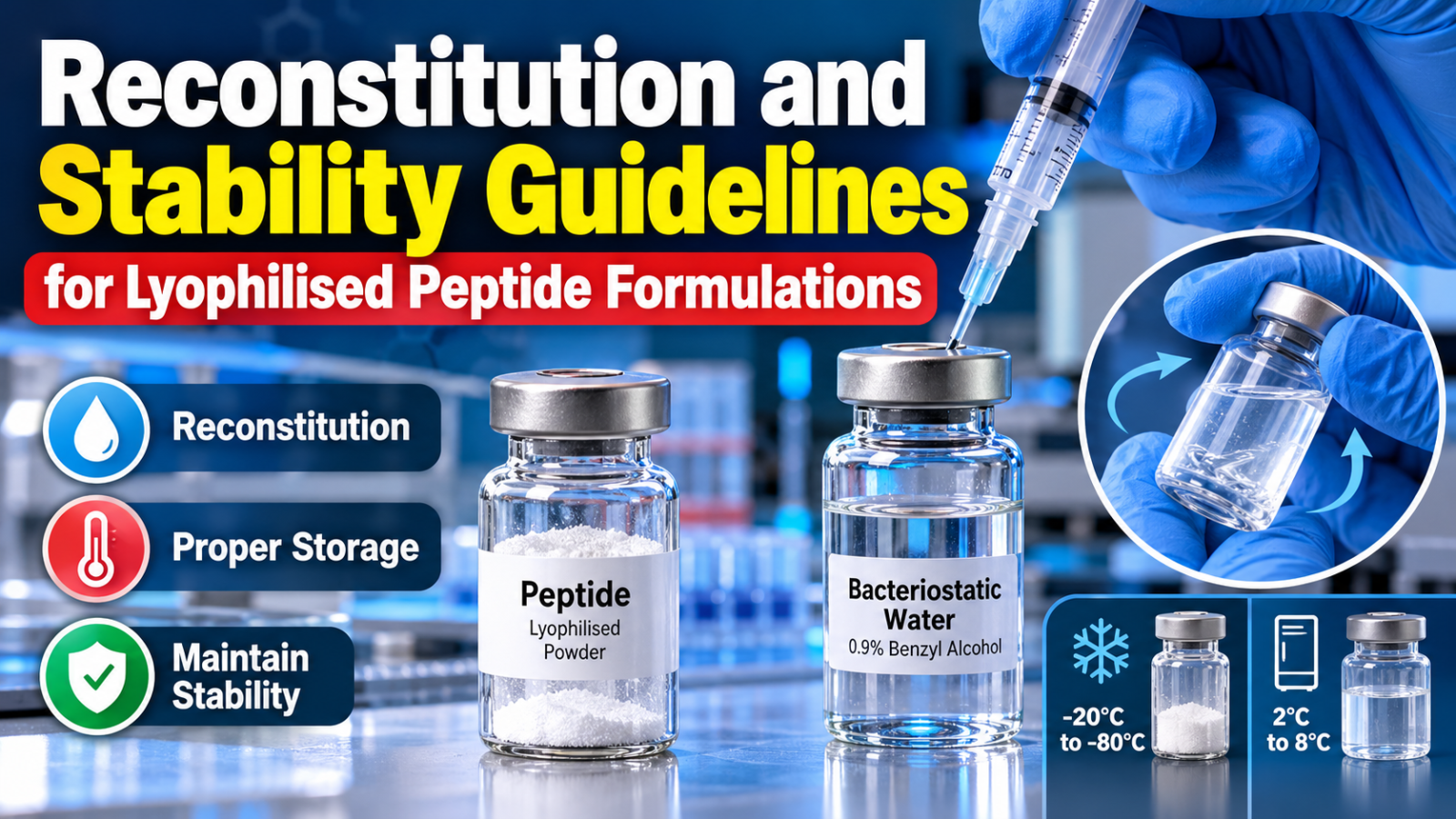
Peptides are frequently used in labs in their lyophilised form due to the fact that they remain fresh in their freeze-dried state. It is important to mix dry powder correctly with a liquid. This will maintain the functionality, surface, and form of the peptide. It also adds to your successful test results.
It is essential to know the correct way to mix peptides with growth hormone secretagogues and how to store them. This will help in maintaining the stability of molecules during testing. High laboratory standards should be maintained. For instance, you can ensure the right molar ratios and avoid their breakdown during handling. This helps in ensuring that their structure remains intact. In cases where one decides to use high-purity synthetic peptides, such as the Cjc 1295 + Ipamorelin + CJC-1295, one has to be cautious and ensure that they set it up right. This helps to stabilize the chain of action for the two pathways.
Understanding Lyophilisation and Peptide Stability
Water is eliminated from the peptide in a procedure known as lyophilisation. This is accomplished by using a vacuum process, where water is not first converted to the liquid state. In this way, it is possible for you to avoid degradation, damage by air, and damage caused by enzymes to the peptide in storage.
Key Factors Influencing Stability
- Temperature: An increase in temperature leads to breakdown and shapelessness of the molecules.
- pH Values: It should be noted that the pH values must be close to neutral in order for solvents to maintain the integrity of the second layer of the molecule.
- Mechanical Pressure: The solvent is shaken, which causes the breaking of weak bonds and therefore the formation of connections.
- Ultraviolet Light: Ultraviolet light may initiate chemical reactions, mainly in the case of peptides with some kinds of amino acids.
Step-by-Step Reconstitution Protocol
When you stick to the correct procedure, there is less risk of contamination by bacteria. This will also prevent breakage of materials during preparation of the solution.
- Temperature Equilibration
Allow freeze-dried powder to come to room temperature (20 – 25C) before opening the vial. When a cold vial is opened, the dry powder comes into contact with the air. This causes condensation to occur on the powder that hastens its breakdown.
- Sanitisation
Use 70% isopropyl wipes to wipe both the diluent vial and peptide vial rubber stoppers. Let the stoppers dry in the air completely. This prevents chemicals from entering.
- Solubilisation and Diluent Selection
Use clean bacteriostatic water (0.9% benzyl alcohol) when you need to make several lab tests. This will prevent the growth of germs.
- Add Slowly: Put the diluent against the glass wall of the vial. Do not place directly on the dry cake.
- Gentle Swirl: This involves simply rotating the vial in your hand or swirling it to ensure that it completely melts. Avoid shaking the vial.
Storage and Handling Best Practices
| Form | Storage Temperature | Expected Shelf Life | Notes |
| Lyophilised (Dry Powder) | -20°C to -80°C | 12 to 24 Months | Keep sealed away from moisture and direct light. |
| Reconstituted Solution | 2°C to 8°C (Refrigerated) | 3 to 4 Weeks | Do not leave at room temperature; avoid unnecessary freeze-thaw cycles. |
Conclusion
How to properly blend and stabilize the peptides is crucial. It allows maintaining the potency of these rather fragile artificial substances. The temperature, the medium for the blending process, the pressure, and the absence of contamination can be controlled. It gives the scientists an opportunity to have consistent results. In case one works with either individual secretagogues or combinations such as Cjc 1295 + Ipamorelin + CJC-1295, adherence to the proper blending procedure is required.