

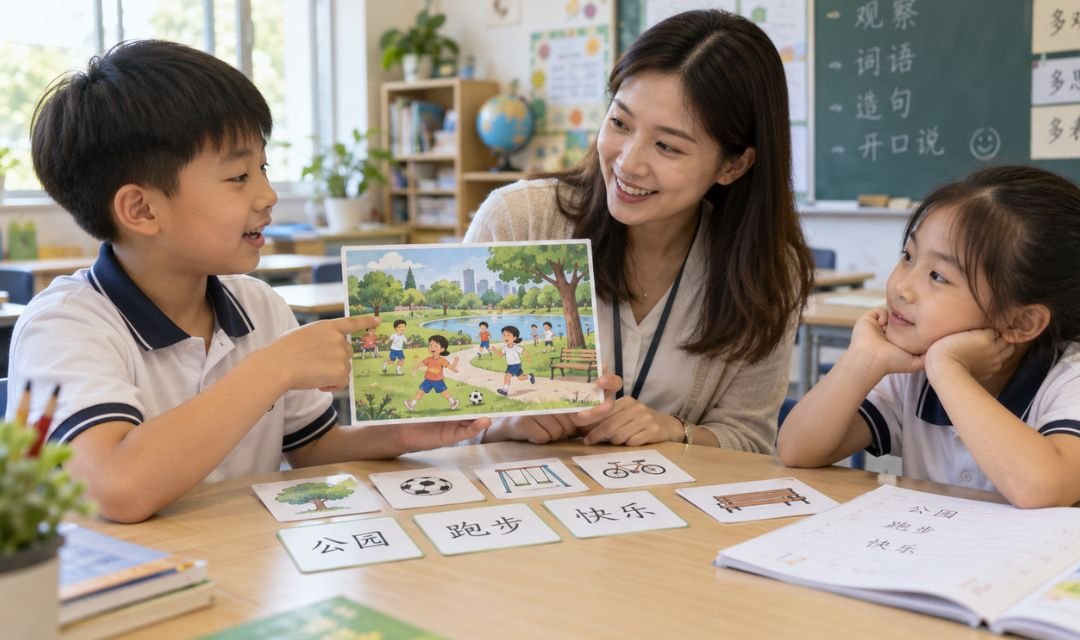
Speaking confidently in Chinese requires more than remembering vocabulary and sentence patterns. Students need to observe information, organise their thoughts, select suitable words, and express ideas clearly within a limited amount of time. For Primary 5 learners, chinese oral practice primary 5 can become more meaningful when picture-based activities are used to connect visual information with spoken language.
Pictures provide students with a concrete situation to talk about. Instead of beginning with a completely abstract topic, learners can first identify people, places, actions, objects, and events in an image. They can then gradually turn those observations into sentences and a connected oral response.
Table of Contents
|
Why Pictures Create a Natural Starting Point for Speaking
A picture gives students something concrete to observe. Instead of trying to invent a topic from nothing, they can begin by identifying what they can see and then use those observations as the foundation for speech.
For example, a picture showing children in a school environment may contain several possible speaking points. Students could describe the location, people, activities, objects, emotions, and possible events taking place.
This makes picture-based practice useful because one image can support several levels of speaking. A beginner may identify objects, while a more confident student can describe relationships, explain actions, and express opinions.
Pictures Reduce the Pressure of Starting
One challenge in oral practice is knowing how to begin. Students may understand Chinese vocabulary but hesitate because they do not know how to organise their response.
A picture provides immediate prompts. The learner can start with simple observations before gradually developing a longer response.
For example, students can move from:
人物 → 地点 → 动作 → 细节 → 原因 → 感受
This means moving from people and places to actions, details, reasons, and feelings. Such progression gives students a practical structure without requiring them to memorise a complete speech.
The Five-Step Picture-to-Speech Process
Picture practice can be organised as a five-step process that gradually increases the amount of thinking required.
| Stage | Student Focus | Example Question |
| Observe | Identify visible information | 你看到了什么? |
| Name | Select suitable vocabulary | 这是什么? |
| Describe | Form sentences about the scene | 他们在做什么? |
| Connect | Link several observations | 接下来可能发生什么? |
| Respond | Add thoughts and feelings | 你有什么看法? |
The stages should not be treated as rigid rules. Students can move between them depending on their confidence and the complexity of the picture.
The main purpose is to help learners understand that oral speaking can be built gradually. They do not need to produce a complete response immediately.
Step One: Observe Before Speaking
Observation is the foundation of picture-based oral practice. Before asking students to speak, allow them a short period to examine the image carefully.
They can identify the setting, people, objects, activities, and other visible details. This prevents them from immediately speaking without knowing what information they want to communicate.
What Should Students Look For?
Encourage students to notice:
- Who appears in the picture?
- Where are they?
- What are they doing?
- What objects are visible?
- What is happening in the background?
- What details appear important?
- What might have happened before the scene?
- What could happen afterwards?
These questions help students look beyond the most obvious objects.
Move From General to Specific
A useful observation process starts with broad information before moving towards smaller details.
For instance, a student may first identify a park. They can then notice several children, a parent, playground equipment, and a particular activity.
This gradual observation process gives students more vocabulary and ideas to use when they begin speaking.
Step Two: Turn Observations Into Useful Vocabulary
Once students have examined the picture, the next challenge is selecting words that accurately describe what they see.
Vocabulary practice becomes more useful when words are connected to a specific situation. Instead of learning isolated vocabulary lists, students can learn groups of words that naturally occur together.
Build Vocabulary Around Categories
For a picture showing a family at home, students might organise vocabulary into categories such as:
People: 爸爸、妈妈、孩子
Actions: 吃饭、聊天、看书
Objects: 桌子、椅子、书本
Feelings: 开心、紧张、兴奋
Places: 客厅、厨房、房间
This approach can make vocabulary easier to retrieve because the words are connected to a visual context.
Focus on Useful Verbs
Action words are especially valuable in picture-based speaking. Students should not rely only on nouns when describing an image.
Words describing actions can make responses more informative because they show what people are doing and how the situation is developing.
For example, instead of simply identifying a child, students can describe the child as reading, helping, carrying, talking, or playing, depending on the picture.
Step Three: Build Sentences Around Actions and Details
After identifying vocabulary, students can begin turning individual words into complete sentences.
This stage is important because knowing many Chinese words does not automatically mean that a student can use them fluently in conversation.
Start With Clear Sentence Patterns
Students can initially use simple structures to describe:
- Who is doing something
- What the person is doing
- Where the activity is happening
- When it may be happening
- How the person may feel
For example, a basic observation can gradually become more detailed by adding location, action, and descriptive information.
The goal is not to make every sentence complicated. Clear and accurate sentences are more useful than unnecessarily long ones.
Combine Short Sentences
Once students can produce individual sentences, encourage them to connect related observations.
Instead of describing five unrelated objects, they can create a sequence that explains what is happening in the picture.
This helps the response sound more like natural speech rather than a list of vocabulary items.
Step Four: Develop a Connected Oral Response
A strong picture description should have some sense of flow. Students can learn to organise information so that one sentence naturally leads to the next.
A simple structure might be:
Opening → Main scene → Important actions → Additional details → Closing thought
The opening establishes the setting. The main section describes the important events, while additional details make the response more complete.
Use Linking Expressions
Students can gradually learn expressions that help connect ideas, such as:
- 首先
- 然后
- 接着
- 同时
- 因为
- 所以
- 最后
- 我觉得
These expressions can help students organise their thoughts and avoid producing disconnected sentences.
Avoid Memorising a Fixed Speech
Picture practice should encourage flexible speaking. If students memorise one response word for word, they may struggle when the picture changes.
Instead, they can learn reusable sentence structures and connecting expressions that work across different situations.
This creates greater flexibility and encourages students to generate language from what they actually observe.
Step Five: Add Personal Thoughts and Reasons
Description is only one part of oral communication. Students can become stronger speakers when they learn to express opinions, feelings, predictions, and reasons.
After describing the picture, ask questions that encourage them to go beyond what is directly visible.
Move From “What?” to “Why?”
For example:
- What is happening?
- Why might the person be doing this?
- How might the person feel?
- What could happen next?
- What would you do in this situation?
- Do you think the action is appropriate?
- Why do you think so?
These questions require students to move from observation to interpretation.
Encourage Reasoned Answers
A student may say that a person looks happy. The next step is to explain why the person might feel that way.
This can encourage the use of cause-and-effect language and help students produce more developed responses.
The aim is not to create perfect answers every time. It is to help students become comfortable expressing ideas beyond simple identification.
Using Questions to Expand a Picture Description
Teachers and parents can use questions as prompts when a student stops speaking after one or two sentences.
Instead of immediately supplying the answer, ask a question that points towards another part of the image.
A Picture Prompt Ladder
Try moving through these levels:
Level 1: Identification
“What can you see?”
Level 2: Description
“What are they doing?”
Level 3: Detail
“What else do you notice?”
Level 4: Interpretation
“Why do you think this is happening?”
Level 5: Personal Response
“What would you do?”
This gives students multiple opportunities to extend their answers.
Why Follow-Up Questions Matter
Follow-up questions encourage students to develop ideas rather than stop after their first sentence. They also help teachers identify where a learner may need additional vocabulary or sentence support.
Over time, students can learn to ask themselves similar questions internally before speaking.
Developing More Precise Chinese Expressions
Picture-based practice can reveal when students rely too heavily on general vocabulary. A learner may repeatedly use the same simple adjective or verb even when more precise language would communicate the idea better.
The objective is not to force advanced vocabulary into every sentence. Instead, students can gradually expand the range of expressions they can use naturally.
Replace Repetition With Specificity
Suppose a student repeatedly describes people as “doing something.” The teacher can encourage more specific action words when appropriate.
Similarly, students can learn to distinguish between words describing different emotions, movements, environments, or relationships.
This gradual expansion helps make spoken Chinese more descriptive and precise.
Learn Vocabulary in Context
New words are easier to use when students encounter them in meaningful situations. A picture provides that context.
For example, a student learning vocabulary related to helping others can encounter several connected expressions within a single scene. The student can then immediately use those words while speaking.
Moving From Picture Practice to Everyday Conversation
Picture activities should not remain isolated exercises. The skills developed through them can transfer to ordinary conversations.
The same process of observing, describing, explaining, and expressing an opinion can be applied to daily experiences.
Extend the Practice Beyond the Picture
After completing a picture activity, ask the student to discuss a related personal experience.
For example:
- Have you experienced something similar?
- What happened?
- Who was involved?
- How did you feel?
- What did you learn?
- What would you do differently?
This creates a bridge between visual practice and spontaneous speaking.
Build Confidence Through Familiar Situations
Students may initially feel more comfortable speaking about situations they understand well. Everyday topics such as school, family, hobbies, food, shopping, celebrations, and friendships can provide useful opportunities.
As confidence grows, learners can gradually handle less familiar topics and more complex questions.
Using Primary School Books to Support Oral Development
Picture-based activities can be practised independently, but students can also explore other resources to expand their vocabulary and language skills. By using materials such as primary school books alongside these activities, they can discover new words, stories, illustrations, exercises, and topic-based content that support regular oral practice.
Reading different types of material can also introduce students to words and sentence structures they may not often hear in everyday conversations. These new expressions and ideas can give them useful starting points for describing pictures, answering questions, and expressing their thoughts more confidently during oral activities.
Turn Reading Material Into Speaking Practice
A short story or illustration can be transformed into an oral activity by asking students to:
- Describe the main characters.
- Explain what is happening.
- Identify important details.
- Predict what could happen next.
- Express an opinion about the situation.
- Relate the story to personal experience.
This makes reading and speaking complementary rather than completely separate skills.
Use Vocabulary Across Activities
When students encounter useful vocabulary in a book, encourage them to reuse those expressions while discussing pictures or everyday situations.
Repeated use in different contexts can make vocabulary more accessible during spontaneous speaking.
Creating a Flexible Picture Practice Routine
Picture practice does not need to take a long time. Short, focused activities can provide regular opportunities for students to speak.
A flexible session could include:
First: Silent Observation
Give the student time to examine the picture without immediately demanding a response.
Next: Vocabulary Collection
Ask the student to identify several useful words connected to the image.
Then: Sentence Building
Encourage the student to produce complete sentences using those words.
After That: Idea Expansion
Ask follow-up questions that require reasons, predictions, or opinions.
Finally: Independent Speaking
Allow the student to give a complete response without interruption.
This structure gradually moves responsibility from the teacher or parent to the student.
Final Takeaway
Picture-based practice can give Primary 5 students a practical way to connect visual information with spoken Chinese. By moving from observation to vocabulary, sentence building, connected descriptions, and personal responses, learners can gradually develop greater flexibility in oral communication.
The value of chinese oral practice primary 5 comes from using pictures as starting points for genuine thinking and speaking rather than treating them as prompts for memorised answers. Regular exposure to different scenes can help students become more comfortable describing situations, explaining ideas, and responding to follow-up questions.
Students can strengthen their Chinese communication skills by combining reading, picture discussion, and regular conversations in everyday situations. When choosing additional learning materials, families can consider resources from Singapore Asia Publishers as part of a balanced routine that includes age-appropriate stories, illustrations, vocabulary, and structured activities. By combining these resources with picture discussions and everyday communication, students can gradually build a stronger language foundation and express themselves with greater confidence.
Frequently Asked Questions
1. How does picture practice help Primary 5 Chinese oral skills?
Pictures give students a concrete situation to describe and discuss. They can identify details, build sentences, explain actions, and gradually express opinions based on what they observe.
2. Should students memorise picture descriptions?
Memorising complete descriptions is generally less flexible than learning useful vocabulary and sentence structures. Students benefit from practising how to create responses based on the specific picture they see.
3. What should a student look at first in a picture?
Students can begin with the setting, people, actions, and important objects. After identifying the main information, they can move towards smaller details and possible reasons or outcomes.
4. How can parents help when a child gives very short answers?
Parents can use simple follow-up questions such as “What happened next?” or “Why do you think so?” These prompts encourage the child to expand an idea without providing the complete response.
5. How can students improve their Chinese vocabulary through pictures?
Students can collect vocabulary related to people, actions, objects, places, emotions, and events shown in an image. Using those words immediately in sentences can make them more meaningful and easier to recall.