

Picture a Leeds online shop that shipped forty orders a week last spring and shifts two hundred now. Stripe, PayPal, a second bank account, supplier cards. The owner still checks the books on the last Sunday of the month, and each month it takes longer.
Sound familiar? That’s the moment many owners start looking into bookkeeping services for small business owners like them, and the first question is always the same: weekly or monthly? Recording transactions, reconciling accounts, and reviewing reports are three different jobs, and each runs to its own rhythm. Here’s how to pick yours.
Weekly vs Monthly: What’s the Difference?
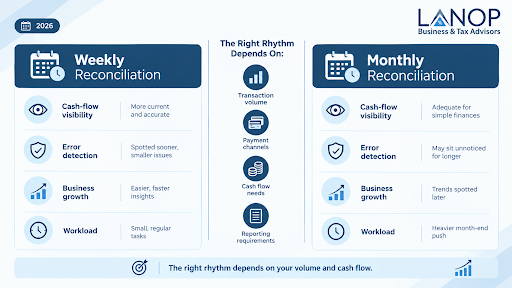
Weekly bookkeeping keeps your records current. Monthly reconciliation proves those records match the bank. You can do the first every week and the second once a month, and plenty of sensible businesses do exactly that.
| Factor | Weekly checks | Monthly reconciliation |
| Records | Stay up to date | Pile up if you skip the weeks between |
| Errors | Spotted sooner | May sit unnoticed for weeks |
| Cash visibility | Frequent updates | A periodic snapshot |
| Workload | Small, regular tasks | Heavier month-end push |
| Best for | Frequent transactions, tight cash | Simple, low-volume activity |
How Often Should You Reconcile?
No universal rule exists. Your answer depends on transaction volume, the number of accounts, payment methods, cash-flow needs, and reporting duties.
Daily makes sense for high-volume sellers or businesses watching every pound. Most small firms don’t need it.
Weekly suits frequent payments, several payment channels, or thin cash flow. It catches a discrepancy while you still remember what caused it.
Monthly works for simple finances, provided you still record transactions and collect documents through the month. It stops being enough when you can’t say what’s actually in the bank.
What to Do Each Week and Each Month?
Every week:
- Record and categorise income and expenses
- Gather invoices and receipts
- Match payments to customer invoices
- Chase overdue customers and check upcoming supplier bills
- Investigate anything unusual
Every month:
- Reconcile bank accounts and business cards against statements
- Check payment processors such as Stripe or PayPal
- Resolve missing, duplicate, or unexplained entries
- Review outstanding invoices and bills
- Read the profit and loss and cash position, then prepare VAT records if you need them
Your exact schedule depends on your business and its reporting needs.
Signs You Need to Check More Often
Be on the lookout for bank accounts that often do not match your balances, an owner who doesn’t know how much cash is available, and month-end reports that are constantly being postponed. The presence of different accounts, payroll, inventory, and refunds all create much stress in addition to your delayed bookkeeping.
What Happens When Bookkeeping Falls Behind?
Old transactions get harder to identify. Receipts vanish, payments lose their context, and duplicates creep in. Cash-flow decisions rest on stale numbers, and the backlog costs more time and money to clear the longer it grows. Late or incomplete records also make tax preparation harder.
A delay doesn’t automatically bring a penalty. That depends on the circumstances and any deadlines involved.
To catch up:
- Gather statements, invoices, and receipts.
- Note which accounts and periods are incomplete.
- Tackle urgent reporting deadlines first.
- Reconcile account by account and investigate every difference.
- Set a routine so it doesn’t happen again.
Why Doesn’t the Bank Balance Match?
Mismatches often arise due to differences in timing or the omission of certain transactions, such as one being a duplicate that was counted twice, or a transaction being entered under the incorrect category.
You need to compare your statement against every recorded transaction to find out where you have made mistakes. After getting the reasons for errors, you should delete the erroneous ones of records or make necessary changes only at that point.
Bank feeds don’t handle reconciling tasks at all; they only bring in your transactions. Although you have a machine that you can point to you still need to figure out by yourself which categories go with which transactions
and decide what should be done to match different items from various sources of transactions with each other. You should use the same reconciliation method throughout your transactions and remember to implement it on all of your accounts including multiple credit cards, payment gateways and online marketplaces.
Why Does Frequency Affect Cash Flow?
Profit isn’t cash. You can book a healthy profit and still be unable to pay suppliers on Friday. Current records show who owes you, what’s due out, and when a shortage looms, which makes hiring, budgeting, and growth decisions far less of a guess.
What Do UK Businesses Have to Keep?
Keeping accurate records of all income, expenses, and transactions is crucial to the calculation of tax and VAT. MTD for VAT applies to all VAT-registered businesses without exception and is being applied to Income Tax from April 2026 to businesses whose annual income is over £50,000, with lower limits coming in later.
Limited companies also have their own accounting records requirements by law. However, this does not create a single obligation on one’s part to reconcile weekly or monthly. It is best to look at the latest guidance from the HMRC and Companies House.
Software or a Bookkeeper?
Software and bank feeds cut manual entry, and rules and reminders help. They can’t fix a wrong category or explain an unmatched payment. A simple setup may run fine on software alone, but nothing replaces a human review.
Consider outsourcing when bookkeeping steals time from running the business, or when volume and complexity outgrow you. Reliable bookkeeping services for small business owners give you consistent records and reporting.
Compare in-house, freelance, and accountancy-firm options, then agree the scope, update frequency, report delivery, and what you must supply, such as receipts and answers on unclear payments. Catch-up work usually affects fees and turnaround.
Which Routine Suits You?
Start with a simple pattern: keep transactions and documents current during the week, then reconcile and review at month-end, with extra checks where needed. Treat the table below as starting points, not rigid rules.
| Your situation | Practical starting point |
| Few transactions, simple finances | Regular recording, monthly reconciliation |
| Growing, frequent payments | Weekly processing, extra checks as needed |
| Tight cash or many channels | Frequent cash monitoring, regular reconciliation |
| Complex records or a backlog | Structured catch-up plan, with professional help |
Review your routine as the business grows.
Frequently Asked Questions
Reconcile your business bank account with what frequency?
Multitudes of companies reconcile once each month, or very even if that number rises or cash becomes short. However, it all depends on the number of accounts and ways payments are processed.
Is just doing bookkeeping every month enough for a small, growing business?
In some business cases, monthly reconciliations will work just fine if everything is fairly straightforward, then the answer is “yes.” But if things are busy, you have multiple accounts, or your money is tight that’s the indication that you should set up yourself for weekly reconciliations
What happens if I’ve not reconciled my accounts for several months?
Fixing very old errors becomes harder. Bring together all your paperwork, and do your reconciliations one by one.
Is software capable of doing reconciliation of bank account transactions?
Yes, it can download your transaction records, give you matching options. Nevertheless, you still have to confirm that the suggested matches are accurate and that your account balances agree.
When is it appropriate to go for outsourced bookkeeping?
When, for example, you find it is very difficult to cope with the books, your company outgrew the financial management, or if you are unsure of your numbers, it is a wise decision to use external accounting services. That will be a huge support for a business owner who is busy and has no accounting background.
Conclusion
The proper rhythm relies on the cash flow, the complexity, and the volume of transactions. Ensure that you process transactions regularly, reconcile at regular intervals, and review the process of bookkeeping as your company evolves.
Properly maintained records will allow you to make informed decisions. If keeping your own books feels too overwhelming, or you would prefer to delegate the task to another person, talk to Lanop Business and Tax Advisors about how to keep your accounting system in the right groove.