

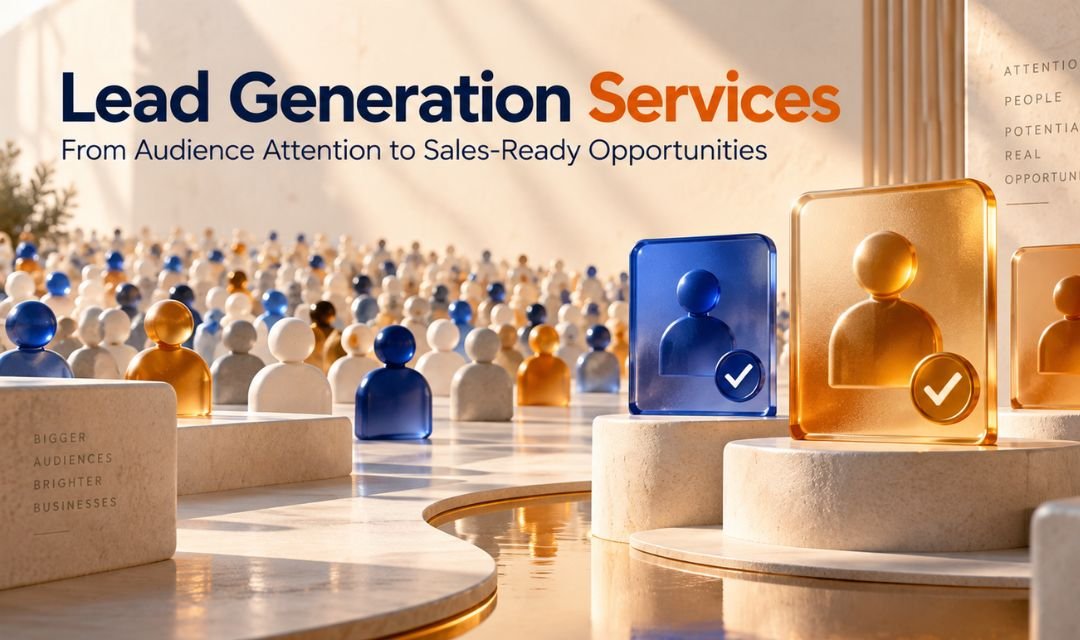
Marketing becomes valuable when it creates opportunities for meaningful customer conversations. Traffic, impressions, and engagement can support awareness, but businesses ultimately need prospects who show genuine interest. Effective lead generation services are designed to move potential buyers from initial discovery toward a clear next step.
The process works best when targeting, messaging, conversion paths, and qualification all support one another.
Attention Is Only the First Stage
A marketing campaign may reach a large audience without producing qualified inquiries.
This usually happens when the message is too broad or the targeting does not reflect the actual customer profile.
Lead generation services should therefore begin by identifying who the business wants to attract.
Define Customer Characteristics Clearly
Useful audience definitions can include business needs, job responsibilities, location, industry, purchasing behavior, or other relevant traits.
The more clearly a business understands its target audience, the easier it becomes to build appropriate messages and offers.
This does not mean narrowing campaigns excessively. It means avoiding attention that has little chance of becoming meaningful demand.
Use Messaging That Reflects Real Problems
Potential customers respond more strongly when marketing reflects challenges they recognize.
Generic promotional language may attract some attention, but specific communication often feels more relevant.
Lead generation services can use customer research, search behavior, and sales feedback to identify recurring concerns.
Speak to Outcomes
Prospects generally care less about internal processes than about what improves for them.
Messaging can explain how a solution addresses a challenge, simplifies a task, improves efficiency, or creates another meaningful outcome.
This helps prospects understand why they should continue engaging.
Create Logical Conversion Paths
Once interest exists, the next step should be easy to understand.
Landing pages, forms, and calls to action should work together naturally.
Businesses seeking qualified lead generation support can improve campaign performance by removing unnecessary friction from these conversion points.
Do Not Ask for Too Much Too Soon
Lengthy forms may discourage early-stage prospects.
Businesses should request only the information necessary for the current stage of the customer journey.
Additional qualification can happen later when prospects demonstrate greater interest.
Distinguish Leads by Intent
Not every lead should receive the same treatment.
Some people may be exploring options casually, while others are actively looking for a provider.
Lead generation services can use behavioral and form data to identify stronger intent signals.
This can help sales teams prioritize follow-up.
Connect Marketing With Sales Feedback
Marketing teams see campaign data, while sales teams hear directly from prospects.
Both perspectives are valuable.
If sales repeatedly reports that certain leads are unsuitable, marketing can refine targeting.
If specific questions arise frequently during sales conversations, those concerns can be addressed earlier in campaign messaging.
Lead Quality Is a Shared Metric
Marketing should not focus exclusively on the number of leads generated.
Sales should not evaluate campaigns solely from isolated conversations.
Both teams benefit from agreeing on common definitions for lead quality and conversion stages.
This creates more useful performance discussions.
Test the Complete Funnel
Optimization should extend beyond advertisements or landing pages individually.
Businesses can test headlines, targeting, page copy, forms, calls to action, qualification methods, and follow-up timing.
Lead generation services use these tests to identify weak points throughout the funnel.
An improvement in one stage can increase overall performance even if traffic levels remain unchanged.
Measure Business Outcomes
Lead volume is useful, but it does not tell the whole story.
Organizations should also monitor qualified lead rates, source quality, follow-up outcomes, conversion patterns, and sales progression.
These measures provide a more realistic view of campaign effectiveness.
Conclusion
Successful lead generation connects audience targeting with persuasive messaging, simple conversion paths, appropriate qualification, and continuous measurement.
Lead generation services can help businesses turn scattered marketing activity into a structured acquisition system.
By focusing on the quality of opportunities rather than raw contact volume alone, organizations can give sales teams stronger prospects and build a more predictable path from initial attention to meaningful customer conversations.