

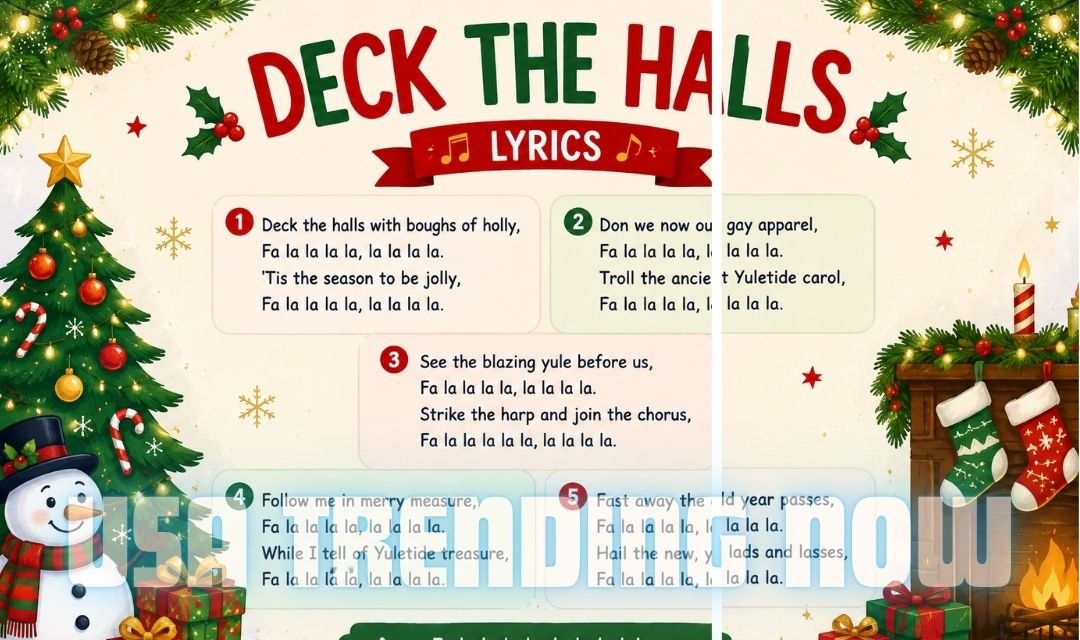
Deck The Halls Lyrics are among the easiest and happiest Christmas song words to sing with family and friends. Famous for the cheerful “fa la la” chorus, Deck the Halls comes from a traditional Welsh melody called Nos Galan, meaning “New Year’s Eve.” The English words associated with the carol appeared in the nineteenth century, and different versions developed before the familiar family-friendly lyrics became standard. Today, it remains a favorite at Christmas parties, school performances, family gatherings, and holiday sing-alongs.
Quick Facts About Deck The Halls
| Detail | Information |
|---|---|
| Song | Deck the Halls |
| Original Title | Deck the Hall |
| Type | Traditional Christmas and New Year carol |
| Melody | Traditional Welsh melody |
| Original Welsh Tune | Nos Galan |
| Meaning of Nos Galan | New Year’s Eve |
| English Lyrics | Thomas Oliphant |
| English Lyrics Published | 1862 |
| Modern Family-Friendly Version | Developed by the late 1800s |
| Famous Words | “Deck the halls with boughs of holly” |
| Famous Refrain | “Fa la la…” |
| Public Domain | Traditional historical versions are public domain |
| Main Theme | Decorating, celebrating, singing and welcoming the New Year |
The melody is centuries old, while Thomas Oliphant’s English words first appeared in Welsh Melodies in 1862. A revised 1877 version removed several references to drinking and moved the song much closer to the Christmas carol people commonly sing today.
Full Deck The Halls Lyrics
Here is the familiar traditional version of Deck The Halls Lyrics:
Deck the halls with boughs of holly,
Fa la la la la, la la la la.
’Tis the season to be jolly,
Fa la la la la, la la la la.
Don we now our gay apparel,
Fa la la, la la la, la la la.
Troll the ancient Yuletide carol,
Fa la la la la, la la la la.See the blazing Yule before us,
Fa la la la la, la la la la.
Strike the harp and join the chorus,
Fa la la la la, la la la la.
Follow me in merry measure,
Fa la la, la la la, la la la.
While I tell of Yuletide treasure,
Fa la la la la, la la la la.Fast away the old year passes,
Fa la la la la, la la la la.
Hail the new, ye lads and lasses,
Fa la la la la, la la la la.
Sing we joyous, all together,
Fa la la, la la la, la la la.
Heedless of the wind and weather,
Fa la la la la, la la la la.
This widely sung version developed from nineteenth-century forms of the carol. Early printed versions differed in several lines, which explains why you may occasionally hear “Deck the hall” instead of “Deck the halls,” or “Christmas carol” instead of “Yuletide carol.”
What Does “Deck the Halls” Mean?
The word deck does not mean a wooden area outside a house in this song.
Here, “deck” means decorate.
So:
“Deck the halls with boughs of holly”
simply means:
Decorate the house or gathering place with branches of holly.
Holly has been associated with winter celebrations for centuries because its green leaves and bright red berries remain colorful during cold weather.
Imagine a house filled with:
green holly,
Christmas lights,
garlands,
a decorated tree,
music,
food,
and happy people.
That is the atmosphere the opening lyric creates.
What Does “’Tis the Season to Be Jolly” Mean?
This is probably the most famous line in the entire song.
’Tis is an old shortened form of “it is.”
So:
“’Tis the season to be jolly”
means:
“It is the season to be happy and cheerful.”
Today, people use “’tis the season” even outside the song.
You might see:
“’Tis the season for giving.”
“’Tis the season for cookies.”
“’Tis the season for Christmas movies.”
The phrase became strongly connected with the Christmas and holiday season because of the popularity of Deck the Halls.
What Does “Don We Now Our Gay Apparel” Mean?
This line sometimes confuses younger listeners because some of the words are used differently today.
Don means put on.
Gay historically could mean bright, cheerful, festive or colorful.
Apparel means clothing.
Therefore:
“Don we now our gay apparel”
means something like:
“Let us put on our cheerful festive clothes.”
Think Christmas sweaters, colorful dresses, smart outfits, Santa hats or anything worn for a joyful celebration.
The line is not complicated once the older meaning of the words is understood.
What Does “Troll the Ancient Yuletide Carol” Mean?
This is another line that sounds strange today.
The word troll here does not refer to an internet troll or a creature living under a bridge.
An older meaning of the verb was connected with singing loudly or repeatedly.
Yuletide refers to the Christmas season.
So the line essentially means:
Sing the old Christmas song together.
Some historical versions use slightly different wording, including “troul the ancient Christmas carol.”
What Is Yule?
The song contains several references to Yule and Yuletide.
Today, the word is often used as another name for Christmas or the Christmas season.
Its history is much older, with roots in Germanic midwinter celebrations.
Over time, the word became closely associated with Christmas traditions.
That is why phrases such as:
Yule log,
Yuletide,
and Yuletide carol
still appear in Christmas songs and decorations.
What Does “See the Blazing Yule Before Us” Mean?
This line usually brings to mind a warm fire.
Historically, the Yule log was associated with winter celebrations.
So “see the blazing Yule before us” creates an image of people gathered around a warm fire while celebrating together.
Imagine cold weather outside.
Inside, everyone is warm.
The fire is glowing.
Music is playing.
People are singing.
That cozy picture fits the entire mood of Deck the Halls.
Why Does Deck The Halls Say “Fa La La”?
The “fa la la” section is probably what makes the song so memorable for children.
You do not need to memorize difficult words.
You simply sing:
Fa la la la la, la la la la!
Interestingly, these repeated syllables are older than the familiar English Christmas lyrics.
They were already associated with the Welsh musical tradition from which the melody developed. The English words appeared much later.
The repeated sounds also make the song perfect for groups.
Even someone who does not know every verse can quickly join the “fa la la” part.
Where Did Deck The Halls Come From?
The history takes us to Wales.
The melody comes from the Welsh song Nos Galan.
“Nos Galan” means New Year’s Eve.
The tune is generally traced back several centuries and is commonly described as originating in the sixteenth century, although surviving printed examples appeared later.
Originally, it was not exactly the Christmas song English speakers know today.
The melody existed first.
The familiar English words came later.
That is common with traditional music.
A melody can survive for generations while people change the words, purpose or arrangement.
Who Wrote Deck The Halls?
There are two parts to the answer.
The melody is traditional Welsh music, so there is no single modern composer who can simply be credited with inventing the tune.
The familiar English lyrics are associated with Thomas Oliphant, a Scottish musician and writer.
His English words appeared in 1862 in Welsh Melodies, arranged by Welsh harpist John Thomas. The publication also contained Welsh words by John Jones, known as Talhaiarn.
Oliphant’s version was not simply a word-for-word translation of the Welsh song.
He created new English lyrics that fit the old melody.
Were the Original Lyrics Different?
Yes.
Quite different in places.
Oliphant’s 1862 lyrics included lines about drinking, including references to a mead cup, a barrel and a flowing bowl.
One early verse included:
“Fill the mead-cup, drain the barrel.”
Later publishers changed those lines.
By 1877, a version printed in the Pennsylvania School Journal replaced the drinking references with more family-friendly lines such as:
“Don we now our gay apparel.”
That revised version moved the carol much closer to what children and families sing today.
It is a fascinating example of how a traditional song can change as it moves between generations.
Was It Originally “Deck the Hall” or “Deck the Halls”?
Originally, the title was generally “Deck the Hall.”
Singular.
The familiar plural title “Deck the Halls” became common later, with examples appearing by the late nineteenth century.
Today, most people say and search:
Deck the Halls.
You can still find older sheet music using the singular version.
Neither should surprise you.
They represent different stages of the carol’s history.
Is Deck The Halls a Christmas Song or New Year Song?
Today, it is overwhelmingly known as a Christmas carol.
Historically, things are more interesting.
The Welsh tune came from Nos Galan, a song associated with New Year’s Eve.
The English lyrics then added strong Christmas and Yuletide imagery.
The final verse still clearly looks toward New Year:
“Fast away the old year passes,
Hail the new, ye lads and lasses.”
So Deck the Halls works beautifully for the entire festive period from Christmas into New Year.
That may be one reason it has remained popular for so long.
Is Deck The Halls a Religious Christmas Carol?
Not particularly.
Unlike songs such as Silent Night or O Come, All Ye Faithful, Deck the Halls does not focus on the Nativity, Bethlehem or explicitly Christian worship.
Instead, it focuses on:
decorating,
singing,
celebrating,
winter,
happiness,
and welcoming a new year.
That makes it useful in many different holiday settings.
Schools, community groups and families can sing it as a seasonal song even when the event is not specifically religious.
Why Is Deck The Halls So Popular With Kids?
The answer begins with:
Fa la la la la!
Children can learn that part immediately.
The melody is lively.
The song is short.
The pictures created by the lyrics are easy to imagine.
There are decorations.
Colorful clothes.
Music.
Fire.
Winter weather.
And everybody singing together.
That makes it perfect for school concerts and family Christmas activities.
You can also divide a group into two sections.
One group sings the main words.
The second group answers with the “fa la la” refrain.
Suddenly, even a simple song feels like a performance.
How Many Verses Does Deck The Halls Have?
The commonly sung traditional version has three main verses.
The first focuses on decorating and preparing for the celebration.
The second focuses on music and joining the festivities.
The third watches the old year disappear and welcomes the new one.
However, because the song has existed in different forms for such a long time, lyric collections may show variations.
That does not necessarily mean one website is wrong.
Traditional songs often change slightly over generations.
Why Do Some Deck The Halls Lyrics Look Different?
You may see one version saying:
“Deck the hall”
and another:
“Deck the halls.”
You might see:
“Christmas carol”
or:
“Yuletide carol.”
One version may say:
“While I tell of Yuletide treasure.”
An older one may mention:
“While I sing of beauty’s treasure.”
These changes happened because the song was printed and adapted many times during the nineteenth and twentieth centuries.
For casual Christmas singing, the familiar modern traditional version is usually easiest.
Is Deck The Halls Public Domain?
The traditional song is old enough that its historic melody and nineteenth-century English lyrics are in the public domain.
The Library of Congress maintains many nineteenth-century and early Christmas music collections that are explicitly public domain and free to use and reuse.
However, there is one useful distinction.
A modern recording or arrangement can still have its own copyright.
For example, a singer may record Deck the Halls with a completely new instrumental arrangement.
The underlying old song may be public domain, while that particular recording is protected.
That is why someone can freely sing the traditional song but cannot automatically copy another artist’s recording.
Easy Way to Teach Deck The Halls to Children
Start with only the first two lines.
Sing:
Deck the halls with boughs of holly.
Then let the children answer:
Fa la la la la, la la la la!
Repeat with:
’Tis the season to be jolly.
Once children understand that pattern, the rest becomes much easier.
You can also explain unfamiliar words before singing.
Tell them:
“deck” means decorate,
“don” means put on,
“apparel” means clothes,
and “Yuletide” means the Christmas season.
Suddenly, lyrics that sounded old-fashioned become easy enough for a young child to understand.
Deck The Halls for Christmas Parties
This carol works particularly well at parties because everyone can participate.
You do not need a professional singer.
You do not need to know every line.
Someone who forgets the words can always jump back in when the “fa la la” begins.
That makes it a good choice for:
family Christmas parties,
school celebrations,
caroling groups,
children’s performances,
community events,
and holiday dinners.
Its quick tempo also creates an energetic mood compared with slower Christmas songs.
What Is the Message of Deck The Halls?
The song has a wonderfully simple message:
Celebrate together while you can.
Decorate the room.
Put on festive clothes.
Sing.
Enjoy the company around you.
Do not allow cold winter weather to spoil the mood.
And when the old year ends, happily welcome the new one.
That message feels surprisingly modern despite the age of the melody.
Why Deck The Halls Still Works Today
Christmas traditions change constantly.
Decorations become brighter.
Music styles change.
People communicate differently.
Yet the basic feeling described in Deck the Halls remains familiar.
Families still decorate.
Friends still gather.
People still sing Christmas songs.
Children still become excited about the season.
And almost everyone reaches the end of December thinking about the year that has passed and the new one approaching.
That is exactly what this centuries-old melody eventually came to celebrate.
Final Thoughts
Deck The Halls Lyrics have survived because they are simple, cheerful and almost impossible to hear without wanting to join in.
The history makes the song even more interesting.
The melody began as the traditional Welsh Nos Galan, associated with New Year’s Eve.
In 1862, Thomas Oliphant supplied the English words that introduced the famous phrase “Deck the hall with boughs of holly.”
Later versions changed several lyrics.
Drinking references disappeared.
Family-friendly Christmas imagery became stronger.
“Deck the Hall” gradually became the more familiar “Deck the Halls.”
But one thing survived almost untouched:
Fa la la la la, la la la la.
That playful refrain may be the biggest reason children and adults still enjoy singing it.
You do not need to understand nineteenth-century vocabulary.
You do not need a perfect voice.
You simply join in.
So whether you are decorating your Christmas tree, preparing a school concert, hosting a family party or going Christmas caroling, Deck the Halls remains one of the easiest songs for bringing everyone together.
Frequently Asked Questions About Deck The Halls Lyrics
What are the first words of Deck The Halls?
The familiar version begins “Deck the halls with boughs of holly,” followed by the famous “fa la la” refrain.
Who wrote Deck The Halls?
The melody is traditional Welsh. Thomas Oliphant wrote the English lyrics associated with the carol, first published in 1862.
What was Deck The Halls originally called?
The song was originally commonly titled “Deck the Hall” in the singular. “Deck the Halls” became common later.
What does “deck the halls” mean?
It means decorate the rooms or house for a celebration.
What does “’tis the season to be jolly” mean?
“’Tis” means “it is,” so the line means it is the time of year to be happy and cheerful.
What does “don we now our gay apparel” mean?
In the historical wording, it means put on our bright, cheerful and festive clothing.
What is Nos Galan?
Nos Galan is the traditional Welsh song and melody associated with New Year’s Eve from which the tune of Deck the Halls developed.
Why does Deck The Halls have so many “fa la las”?
The repeated syllables come from the older musical tradition behind the song and help create its lively, easy-to-sing character.
How many verses are in Deck The Halls?
The familiar traditional version normally contains three verses.
Is Deck The Halls a Christmas carol?
Yes. Today it is one of the best-known traditional Christmas carols, although its Welsh melody was originally associated with New Year’s Eve.
Is Deck The Halls a religious song?
It is primarily a festive seasonal song rather than an explicitly religious carol.
When were the English Deck The Halls lyrics written?
Thomas Oliphant’s English words appeared in 1862.
Were the original lyrics different?
Yes. Oliphant’s early lyrics contained references to drinking that were later replaced by more family-friendly lines. A major revised version appeared in 1877.
Is Deck The Halls public domain?
The traditional historic song is public domain, although individual modern recordings and arrangements can still have separate copyright protection.
Can children sing Deck The Halls at school?
Yes. Its cheerful words, simple melody and repeating “fa la la” sections make it especially easy for children’s holiday performances.
Is Deck The Halls about Christmas or New Year?
Both traditions are reflected in the song. The modern lyrics strongly evoke Christmas, while the original Welsh melody and final verse connect it with welcoming the New Year.
For more lyrics, entertainment stories and trending guides, visit USA Trending Now.